liveBook · Manning

Redundancy

As explained in Amazon Web Services in Action, Third Edition: An in-depth guide to AWS

Redundancy is the provision of multiple interchangeable components or paths so that failure of one does not interrupt service.

Redundancy provides multiple interchangeable components or paths so one failure does not interrupt service. In a web application, running several EC2 instances instead of one removes a single point of failure, especially when the components are decoupled. section 16.0

A redundant AWS design distributes both workloads and their supporting infrastructure:

  • Run application instances across multiple Availability Zones, with a subnet in each zone, so an outage in one zone leaves capacity in another. section 16.1.2
  • Place an Elastic Load Balancer between clients and instances so requests can reach surviving instances and avoid failed ones. section 16.1.1 section 16.1.2
  • Use an Auto Scaling group to replace a crashed EC2 instance, or use SQS to decouple message producers from redundant consumers. section 16.1.2

Three production lines

A single pie-production line stops completely when one step fails. Three independent lines can continue producing when one line fails, although they require more machines. The same pattern applies to EC2: three smaller instances can provide redundancy instead of one large instance, with a load balancer directing incoming requests. section 16.1.1
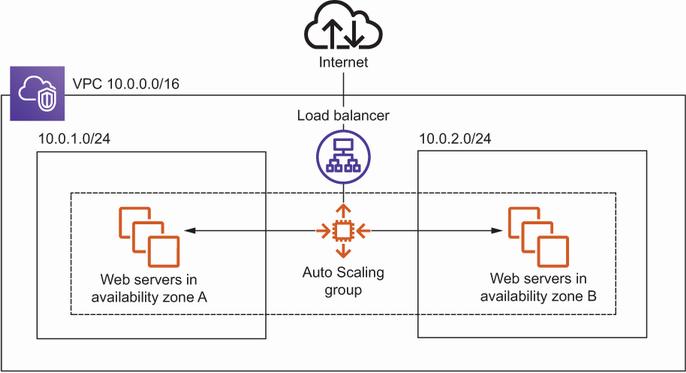
Figure 16.3 Fault-tolerant EC2 instances with an Auto Scaling group and an Elastic Load Balancer

Shows how an Auto Scaling group and Elastic Load Balancer combine with redundant EC2 instances to preserve service after an instance failure. section 16.1.2


How Amazon Web Services in Action, Third Edition: An in-depth guide to AWS covers it

How deep it goes
Explains component replication, Availability Zones, decoupling, and replacement, but stops short of detailed configuration steps.
Examples
Uses multiple pie-production lines and EC2 instances distributed behind a load balancer.
What it assumes
Assumes basic awareness of EC2, Availability Zones, subnets, Elastic Load Balancing, SQS, and Auto Scaling.
What you can do after
Apply redundancy by distributing EC2 instances across Availability Zones and connecting them through load balancing or SQS.
How it connects
Links redundancy with fault tolerance, single points of failure, decoupling, load balancing, message queues, Auto Scaling, and Availability Zones.

Also explained in

Compare how 6 books explain redundancy →

Related concepts

This explainer was generated by Manning's knowledge graph from the text of Amazon Web Services in Action, Third Edition: An in-depth guide to AWS. The section links point to the parts of the book it draws on.



