A register file is the fast, per-SM storage holding values that GPU threads are actively using. Each thread’s registers supply arithmetic operands and receive results; those values are private to the thread. section 3.2.1
Register use affects both data access and concurrency:
- More registers per thread can mean fewer concurrent threads on an SM, reducing the GPU’s ability to hide memory latency. section 3.2.1
- If register demand exceeds physical capacity, the compiler spills values to local memory. Spilled data is backed by global DRAM and may be cached, but accesses remain much slower than register access. section 3.2.1
- In Triton, register management is largely hidden: programmers use local variables while the compiler allocates registers. section 3.2.1
H100 allocation trade-off
An H100 SM has 65,536 32-bit registers. At 32 registers per thread, the example fits 2,048 threads; at 64, it fits 1,024, assuming the SM supports that many concurrent threads. section 3.2.1
Figure 3.3 Memory system of an NVIDIA H100 GPU, showing per-SM register file, unified L1/shared memory, constant caches, the chip-level L2 cache, and HBM3 global memory (with PCIe/NVLink connectivity).
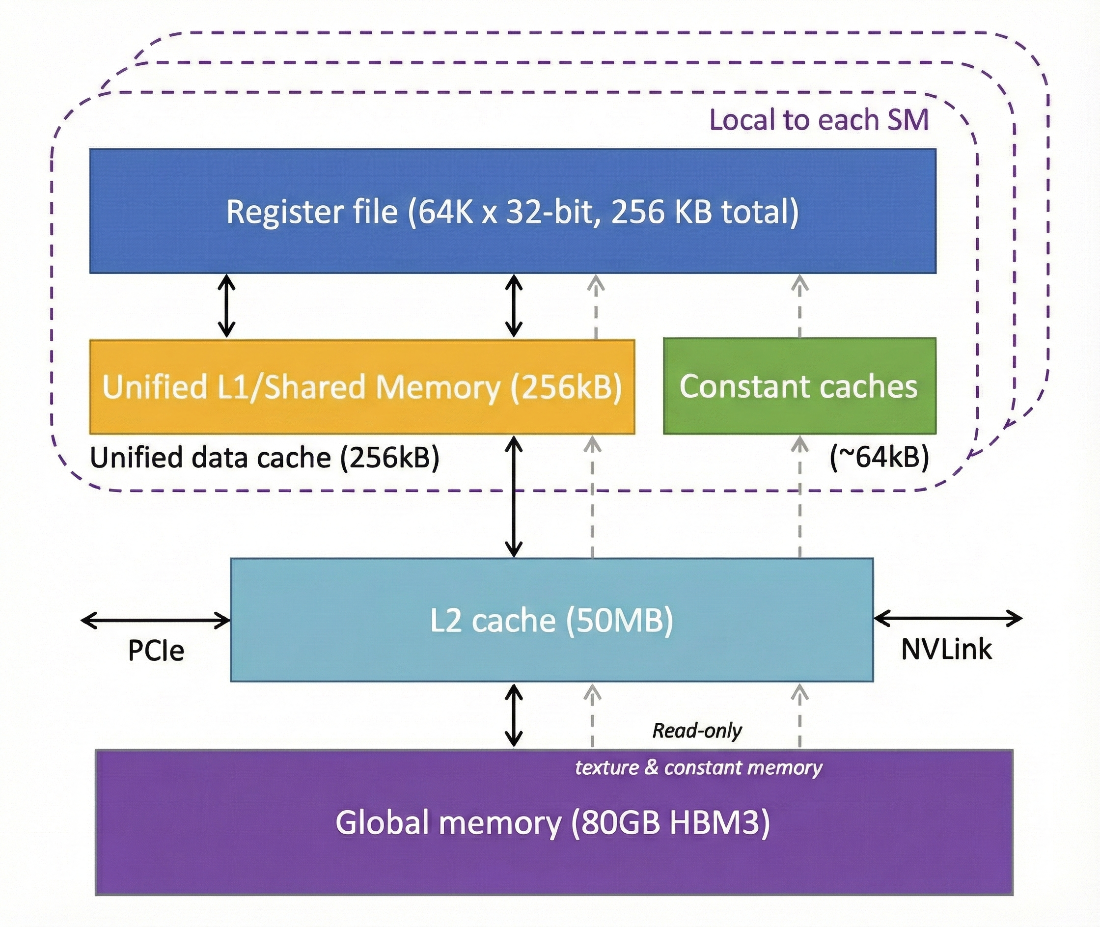
Locate the per-SM register file in the GPU memory hierarchy alongside caches and global memory. section 3.2

