Think of each thread’s registers as private sticky notes on its desk: they hold working values close at hand. An SM has a fixed register file shared among its resident threads, so threads that need more registers leave room for fewer others. section 14.6
More registers, fewer resident threads
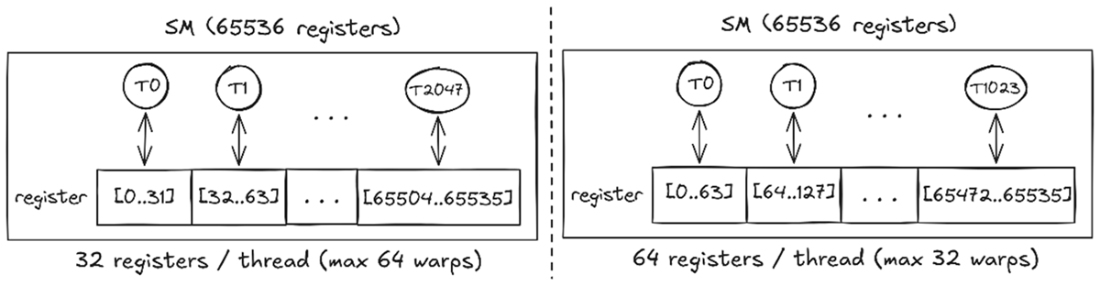
With 65,536 registers, an SM can hold 2,048 threads at 32 registers per thread. At 64 registers per thread, it holds 1,024 threads—half as many. Register use is one limit on occupancy; shared memory and other constraints can also limit residency. section 14.6
Figure 14.4 Registers per thread set a ceiling on occupancy. The SM’s 65,536-register file is shared by every resident thread, so at 32 registers per thread it holds 2,048 threads (64 warps), but at 64 registers per thread only 1,024 threads (32 warps) fit: half the occupancy for double the registers.
Compare how per-thread register use changes the number of resident threads. section 14.6