liveBook · Manning

Release notes

As explained in Infrastructure as Code, Patterns and Practices: With examples in Python and Terraform

Release notes list changes to code for a given release, including changes to interfaces and behavior.

Release notes list code changes for a specific release, especially breaking changes to inputs, outputs, and behavior. Store them in the repository, often as a changelog, so other teams can correlate changes with the released artifact. section 5.3

Use a release-notes workflow that connects tested code, versioning, and published artifacts:

  • Test module updates before releasing them. section 5.3
  • Package and publish the module to an artifact repository or storage bucket when required. section 5.3
  • Update release notes with interface and behavior changes. section 5.3
  • Generate notes automatically with a semantic-release tool, using commit messages in the required format. section 5.3

Secret-manager change

A commit such as “feat(security): store password in secrets manager” can cause an automated release tool to update the major version tag to v2.0.0 and record the change. section 5.3

Figure 5.11 When you make module updates, ensure that you include a testing stage before releasing the module and updating its documentation.
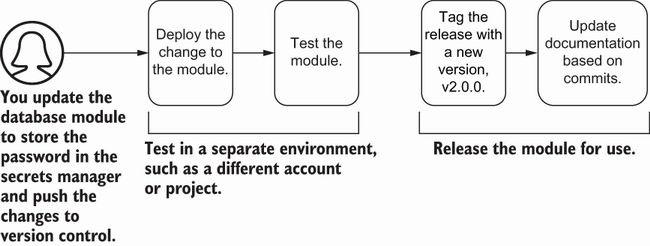
Use the release pipeline figure to trace testing before documentation and publication. section 5.3


How Infrastructure as Code, Patterns and Practices: With examples in Python and Terraform covers it

How deep it goes
Defines release notes, specifies changelog storage, and explains manual or automated generation from commit history.
Examples
Uses breaking interface changes, a secrets-manager feature commit, semantic-release, v2.0.0, S3, and artifact repositories.
What it assumes
Assumes descriptive commit messages and version-control tags while teaching how to record release changes.
What you can do after
Apply semantic-release or manual changelog updates to communicate interface and behavior changes for a release.
How it connects
Connects changelogs with version control, semantic release, commit messages, artifact repositories, and version tags.

Also explained in

Compare how 3 books explain release notes →

Related concepts

This explainer was generated by Manning's knowledge graph from the text of Infrastructure as Code, Patterns and Practices: With examples in Python and Terraform. The section links point to the parts of the book it draws on.
