A reliable agent uses tools and coordinates multi-step workflows while taking safe actions. Reliability means more than producing a plausible answer: actions must be safe, accurate, and dependable under real-world conditions. section 1.0 section 1.4.2
Tool use raises the stakes. Booking Paris, Texas instead of Paris, France can waste money; deleting customer records can destroy years of work. Errors also compound: 85% reliability at each step yields about 20% success across a 10-step workflow. section 1.4.2
Build reliability into the agent’s workflow:
- Use ReAct to cycle through reasoning, action, and observation; planning approaches break complex tasks into steps. section 1.4.2
- Maintain session context with short-term memory and user preferences across sessions with persistent memory; summarize long histories when needed. section 6.5
- Integrate tools consistently to support error handling, traceability, and failure containment; MCP is one standard for connecting agents to external systems. section 1.4.2
- For complex work, coordinate specialized agents and prevent one agent’s mistake from cascading through the system. section 1.4.2
Tool validation, cross-referencing, and guardrails can help prevent hallucinations and improve accuracy. Safe operation at scale also depends on evaluation, monitoring, and responsible AI practices. section 6.5 section 11.6.5
Figure 11.6 The complete AI reliability framework, showing how all three layers connect
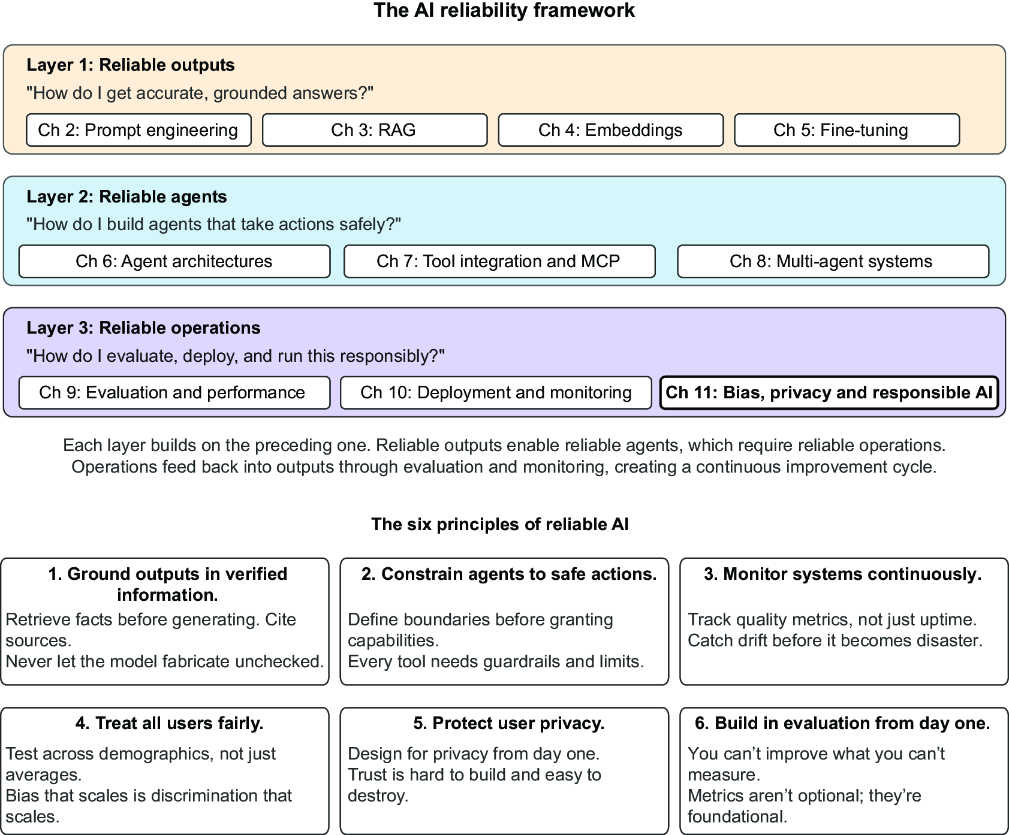
Use the framework diagram to see how reliable agents depend on reliable outputs and, in turn, reliable operations. section 11.6.5
