Replication repeats measurements under the same experimental conditions and averages them. In an A/B test, it reduces natural measurement variation so estimates of each version’s business metric support a more reliable decision. section 2.0 section 2.2.1
A single measurement can fluctuate enough to reverse an apparent choice. Averaging multiple individual measurements produces an aggregate measurement that is typically closer to the metric’s expectation. As the number of measurements grows, aggregate estimates become less variable; standard error summarizes that remaining uncertainty. section 2.2.1
Choosing an exchange by average execution cost
Individual trades sometimes make ASDAQ appear cheaper and sometimes make BYSE appear cheaper. Averaging 100 runs instead gives costs near 12.11 versus 10.01 mips, and another run gives 11.88 versus 10.00. With 300 measurements per exchange, the estimates remain near 12 and 10, making BYSE the reliable lower-cost choice. section 2.1.2 section 2.2.1
Figure 2.3 Histogram of 1,000 aggregate measurements of ASDAQ cost overlaid on histogram of 1,000 individual measurements. Notice that the aggregate measurement histogram is narrower.
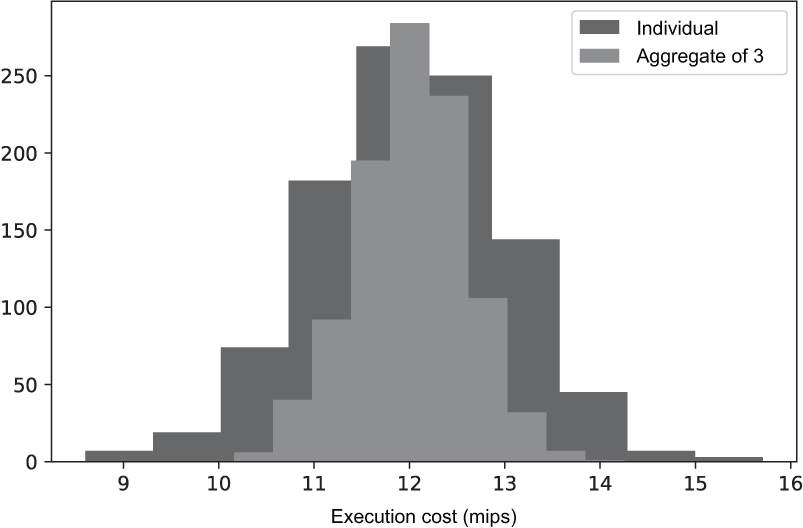
Compare the broad distribution of individual measurements with the narrower distribution of aggregate measurements to see why replication stabilizes an estimate. section 2.2.1
Use replication without confusing it with bias control:
- Choose the number of individual measurements during experiment design; the design specifies a minimum sample count. section 2.0 section 2.4
- Randomize assignment while collecting replicated measurements. Replication reduces variation, but taking conditions at different times can introduce sampling bias rather than remove it. section 2.1.2
- Decide between versions using both practical and statistical significance, not replication alone. section 2.4
- Validate findings later through independent replication, including a validating A/B test, a long reverse A/B test, or a holdout test. section 8.5
Replication also serves validation. Because experiment flaws may persist undetected, independent replication asks whether a result can be reproduced in later experiments rather than merely made more precise within one run. section 8.5 section 8.4.4
