Calibration data is representative input used to observe model activations and derive quantization ranges. If it differs from production traffic, estimated ranges may be too narrow and clip common values, or too wide and waste precision. section 4.0 section 4.2
Build a set that reflects the inputs and activation patterns that matter in deployment:
- Source production data, then sample across user segments, temporal patterns, and important edge cases. section 4.2
- Check layer-wise activation coverage against production behavior and iterate when gaps appear. A few hundred representative samples usually suffice. section 4.2 section 4.5
Figure 4.3 Workflow for preparing a calibration set. The process flows from top to bottom: source production data from logs or traffic samples, apply stratified sampling to cover user segments and edge cases, validate distribution coverage against known activation patterns, and iterate if coverage gaps are found. Each stage includes a quality gate that prevents poorly representative data from reaching calibration.
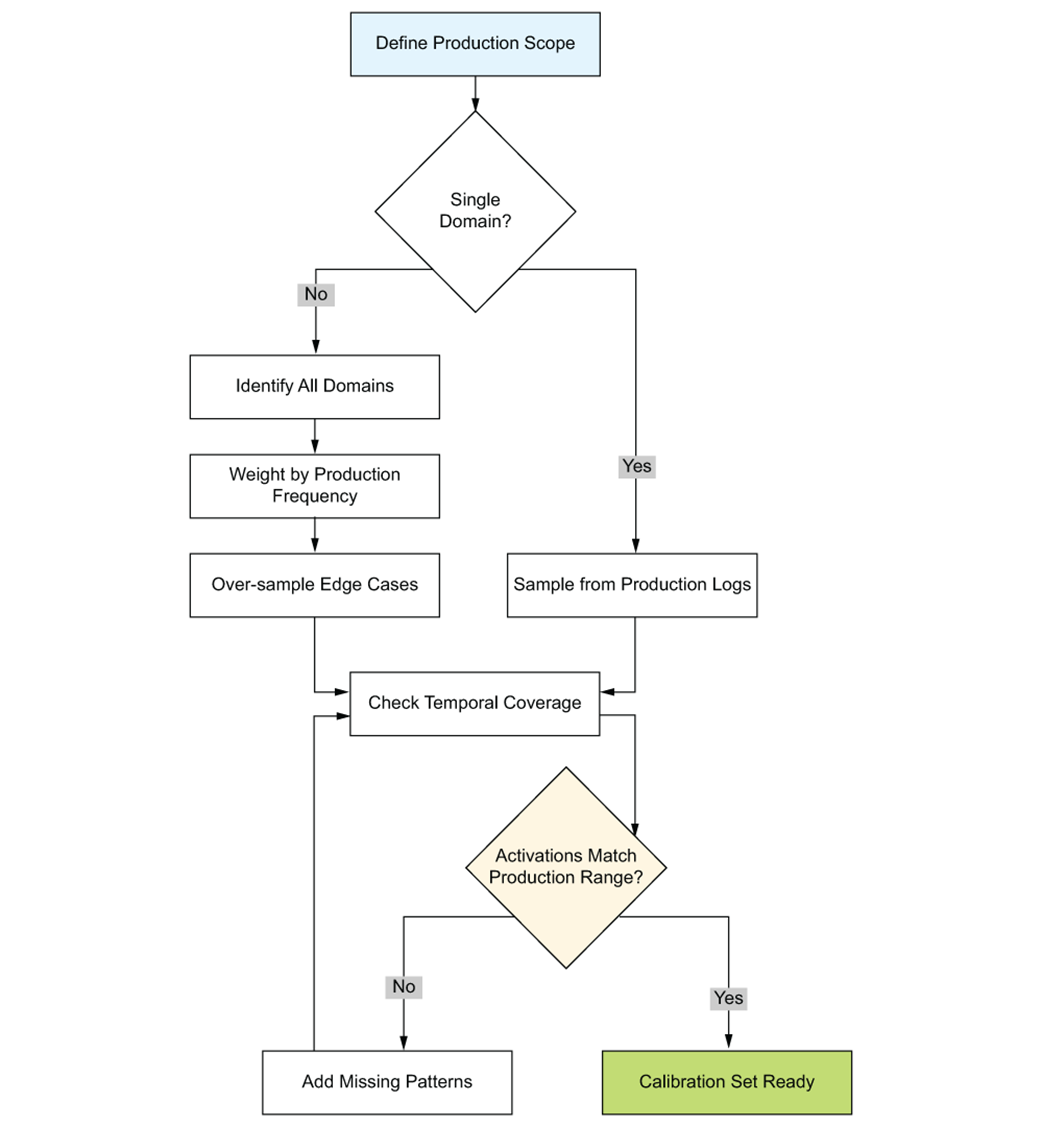
Follow the workflow from production data sourcing through stratified sampling and coverage validation, repeating it when gaps remain. section 4.2
Distribution mismatch
A sentiment model calibrated on polite support messages may encounter angry social posts in production; the resulting activation spikes can exceed calibrated ranges and degrade predictions. Similar mismatches arise between studio photos and security footage, or short queries and long technical documents. section 4.2





