A representative data split partitions a dataset into training and test sets whose distributions, extremes, and intermediate variability reflect the full dataset. This is especially important for small QSAR datasets, where the split affects evaluation of unseen-sample performance and the model’s applicability domain. section 6.2.2
A useful representative split should:
- Cover the full range of binding activity rather than omitting an entire ligand class or response region. section 6.2.2
- Preserve gradual changes in ligand properties so the model can interpolate between known compounds with similar but nonidentical structures. section 6.2.2
- Use the Kennard-Stone algorithm to select a diverse training subset that captures variability across the dataset. section 6.2.2
Small-molecule binding dataset
For 48 ligands spanning five classes, a random split could place all aminoglycosides outside training, reducing observed kₒₙ coverage from [100,107] to [103,107]. Kennard-Stone selection instead uses pairwise sample distances to align training and test distributions and broaden the QSAR applicability domain. section 6.2.2
Figure 6.7 KSA ensures representative sampling from each cluster in this arbitrarily created data set, rather than sampling that is biased towards only one or two clusters.
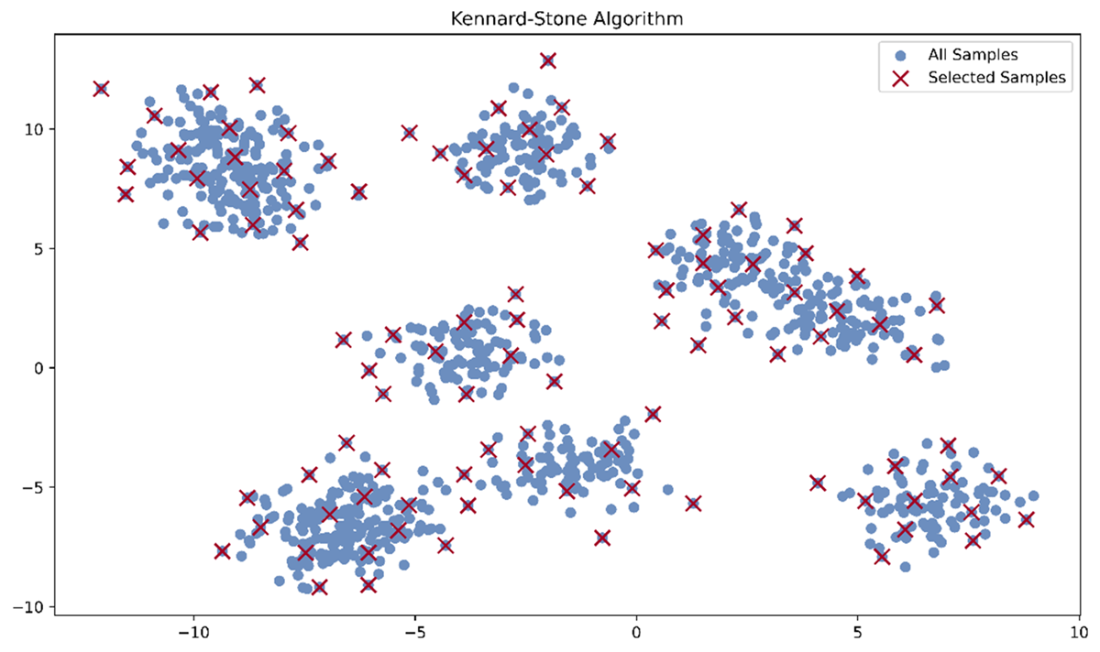
Visualizes how Kennard-Stone sampling covers multiple clusters instead of concentrating selected samples in only one or two regions. section 6.2.2
