The Kennard-Stone algorithm selects a representative training subset by maximizing diversity across molecular descriptors. In QSAR, this helps align train and test distributions and broaden the model’s applicability domain. section 6.2.2 section 6.5
A typical selection procedure is:
- Calculate pairwise distances between samples, using measures such as Euclidean or Mahalanobis distance. section 6.2.2
- Choose initial seeds from the most distant samples, then repeatedly add the remaining sample farthest from the selected subset. section 6.2.2
- Stop after selecting the desired subset size, then use the selected indices for a representative train/test split. section 6.2.2 section 6.2.3
RNA-binding QSAR workflow
For small-molecule RNA-binding data, descriptors can be standardized and compressed with PCA before KSA selects the training samples. A toy dataset illustrates coverage across clusters; the resulting split is checked in chemical space and by comparing response distributions. section 6.2.2 section 6.2.3
Figure 6.7 KSA ensures representative sampling from each cluster in this arbitrarily created data set, rather than sampling that is biased towards only one or two clusters.
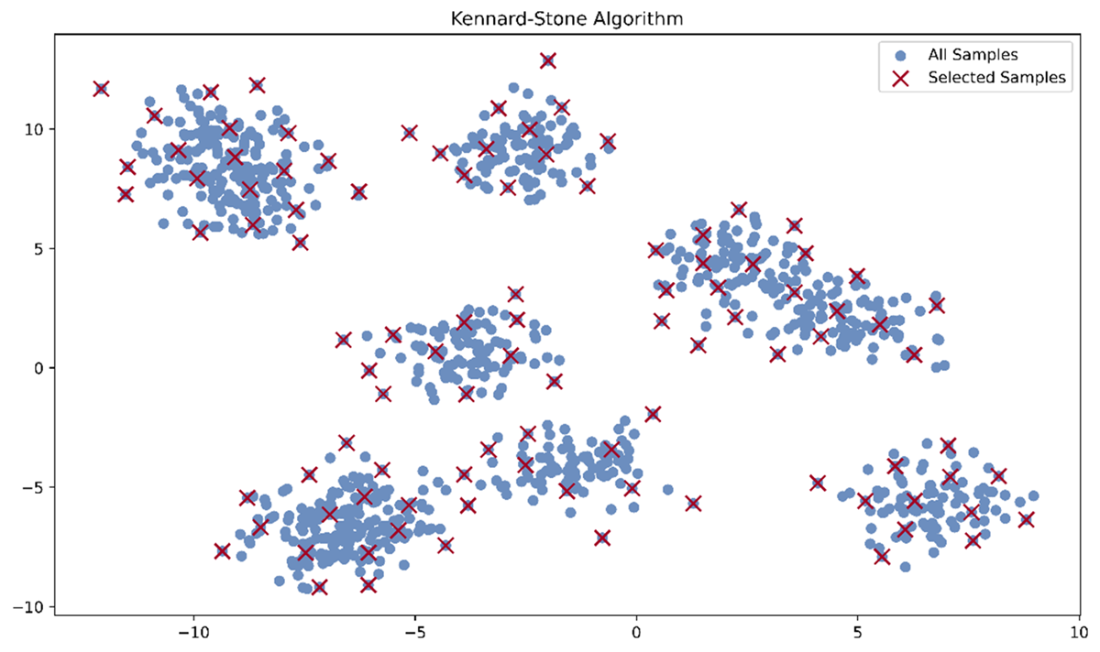
Visualizes how KSA avoids selecting samples from only one or two clusters and instead covers the dataset’s variability. section 6.2.2
