liveBook · Manning

Reschedule mode

As explained in Data Pipelines with Apache Airflow, Second Edition

Reschedule mode is a sensor execution mode in which the sensor releases its task slot after checking the condition and reacquires capacity for later checks.

Reschedule mode lets a sensor check a condition without holding a worker task slot while it waits. The sensor occupies capacity only while it performs the check, then releases the slot for other tasks. section 7.1.2

Avoiding sensor deadlock

A sensor that repeatedly waits for an external condition can consume every available task slot in a DAG or across Airflow. Configure its mode argument as "reschedule" so each check releases capacity afterward. This prevents waiting sensors from blocking unrelated work, although the sensor must reacquire a slot for later checks. section 7.1.2

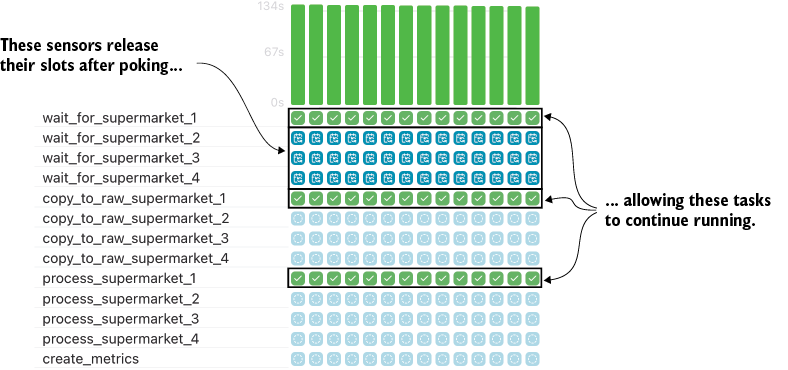
Figure 7.9 Sensors with mode="reschedule" release their slot after poking, allowing other tasks to run.
A screenshot of a computer

AI-generated content may be incorrect.

Use the figure to compare slot occupancy in reschedule mode with sensors that retain their slots while waiting. section 7.1.2

How Data Pipelines with Apache Airflow, Second Edition covers it

How deep it goes
Explains the mode argument, default poke behavior, slot release, and contrast with deferrable operators.
Examples
Uses waiting sensors, repeated condition checks, exhausted task slots, and Figure 7.9's slot-release comparison.
What it assumes
Assumes sensors and task slots; distinguishes reschedule mode from the default poke mode.
What you can do after
Configure a sensor with mode="reschedule" to release worker capacity between condition checks.
How it connects
Connects sensors with task slots, sensor deadlock, Airflow concurrency, and deferrable operators.

Related concepts

This explainer was generated by Manning's knowledge graph from the text of Data Pipelines with Apache Airflow, Second Edition. The section links point to the parts of the book it draws on.