A resource tag is metadata attached to infrastructure to identify, classify, or organize resources by attributes such as customer, ownership, business unit, cost center, or automation status. section 3.4
Use tags to make infrastructure configuration consistent and operationally useful:
- Apply shared default tags through a prototype module instead of hardcoding values across resources. section 3.4
- Use tags to identify network relationships, such as allowing traffic between resources marked blue. section 9.1
- Find untagged resources, verify their usage and dependencies, then stop or delete confirmed waste. section 12.2.1
Shared database-resource tags
A tagging module returns customer, automated, cost-center, and business-unit values. Database servers consume that shared configuration, allowing one update to propagate consistently. section 3.4
Figure 3.7 A module with the prototype pattern returns a copy of static values, such as tags, for consumption by other infrastructure resources.
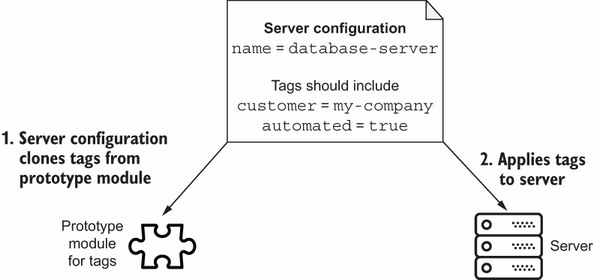
Shows a prototype module returning static tag values for infrastructure resources. section 3.4





