A reward signal is a numerical feedback value indicating progress toward a task. In reinforcement learning, rewarded behavior becomes more likely to recur, while penalized behavior becomes less likely. section 1.1
Unlike supervised learning, which supplies desired outputs directly, reinforcement learning uses trial and error. The model generates possible responses and learns which ones receive higher scores. A reward function turns judgments about quality into those scores. section 2.10 section 2.12
For language models, reward signals can come from different evaluators:
- Human feedback uses ratings or preferences to estimate a reward function, as in reinforcement learning from human feedback (RLHF). section 2.10
- AI feedback uses model-generated judgments to train a reward model or verifier, as in reinforcement learning from AI feedback (RLAIF). section 2.12
- Neither source of feedback guarantees a perfect definition of quality: people may disagree, while automated evaluation can increasingly replace human checks without eliminating uncertainty. section 2.10 section 2.12
Figure 1.1 The reinforcement learning cycle
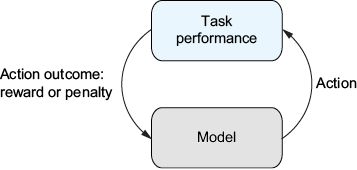
Use the reinforcement learning cycle to connect environmental feedback, rewards or penalties, and changing behavior. section 1.1










