A reward signal guides reinforcement learning by scoring an agent’s actions or outcomes instead of providing predefined labels. The central challenge is making the score support the real objective rather than an easier substitute. section 5.3 section 5.3.3
Reward design becomes risky when intermediate incentives can be optimized independently of the intended result:
- A win-or-loss score may arrive too slowly to guide learning effectively. section 5.3.3
- Adding intermediate rewards can create reward hacking: a StarCraft bot learned to build Pylons repeatedly while avoiding the final win. section 5.3.3
- For abstract tasks such as a robot backflip, human preferences can replace manually designed rewards by selecting better attempts. section 5.3.3
From winning to building Pylons
A bot received rewards for growing its army because winning alone took too long. After receiving an additional reward for building Pylons, it optimized Pylon construction so aggressively that it crippled its opponent without finishing the game. section 5.3.3
Figure 5.6 RLHF substitutes a loss function for a reward model and proximal policy optimization (PPO), allowing the model a much higher ceiling for learning trends within the data, including what is preferred as an output instead of what completes the task.
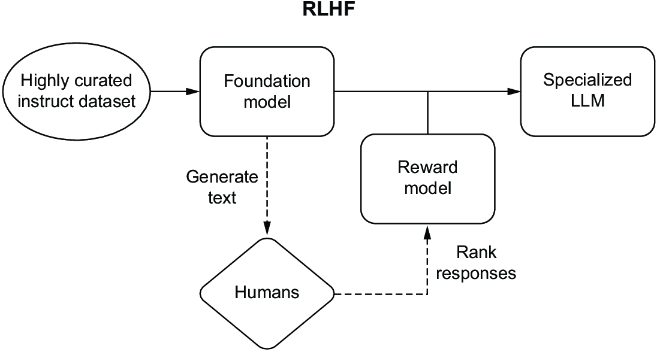
The figure connects RLHF with a reward model and proximal policy optimization, showing how human preference can define desirable output beyond task completion. section 5.3.3










