liveBook · Manning

Rin/rout metric

As explained in Geometry for Programmers

The Rin/Rout metric is the ratio of a triangle's incircle radius to its circumcircle radius.

The Rin/Rout metric measures triangle quality by dividing the incircle’s radius by the circumcircle’s radius. The incircle is the largest circle inside the triangle; the circumcircle is the smallest circle containing it. section 2.2.2

Equilateral triangles achieve the best proportion. As a triangle becomes thinner and approaches degeneracy, the ratio falls toward zero, making it useful for detecting computationally troublesome shapes. section 2.2.2

Use the metric to:

  • Filter strictly degenerate and near-degenerate triangles by rejecting ratios below a chosen small threshold. section 2.2.2
  • Compare triangle shapes when geometric operations become error-prone on extremely thin triangles. section 2.2.2
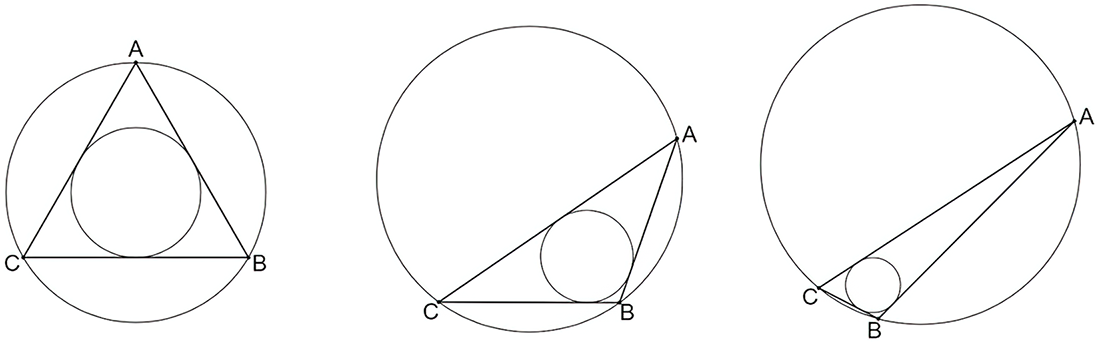
Figure 2.14 The Rin/Rout metric gets smaller as a triangle heads to the degenerate state.
02-14

The figure shows the Rin/Rout metric decreasing as a triangle approaches the degenerate state. section 2.2.2

How Geometry for Programmers covers it

How deep it goes
Defines both circles, explains shape behavior, and stops short of a formal quality-measure survey.
Examples
Contrasts equilateral triangles with increasingly thin triangles and illustrates the decline toward degeneracy.
What it assumes
Defines incircles and circumcircles directly while assuming a triangle as the measured shape.
What you can do after
Diagnose/debug triangle meshes by filtering triangles whose ratio falls below a chosen small threshold.
How it connects
Connects triangle quality with incircles, circumcircles, degenerate triangles, near-degenerate triangles, and triangle meshes.

Related concepts

This explainer was generated by Manning's knowledge graph from the text of Geometry for Programmers. The section links point to the parts of the book it draws on.