Triangle quality describes how suitable a triangle is for geometric computation. It is practical rather than completely formalized: mesh-based algorithms generally need triangles that are not too thin or close to degenerate. section 2.2.3 section 2.8
One useful measure compares the incircle radius with the circumcircle radius: Rin/Rout. Equilateral triangles maximize this proportion, while thinner triangles make it smaller. A strictly degenerate triangle has a value of zero. section 2.2.2
Use the metric to make mesh quality decisions:
- Choose a small-enough threshold and filter triangles whose Rin/Rout falls below it. section 2.2.2
- Treat quality as an algorithmic requirement: supplying a sufficiently good mesh helps geometric algorithms work reliably. section 2.2.3
- Remember that no single quality definition is universally established; choose a metric suited to the computation. section 2.6 section 2.8
Filtering a near-degenerate mesh
Suppose a mesh contains both well-proportioned triangles and needle-like or cap-like triangles. Calculate Rin/Rout for each triangle, then remove or repair those below the chosen threshold. The remaining mesh is better suited to later operations such as ray-triangle intersection. section 2.2.2 section 2.2.3
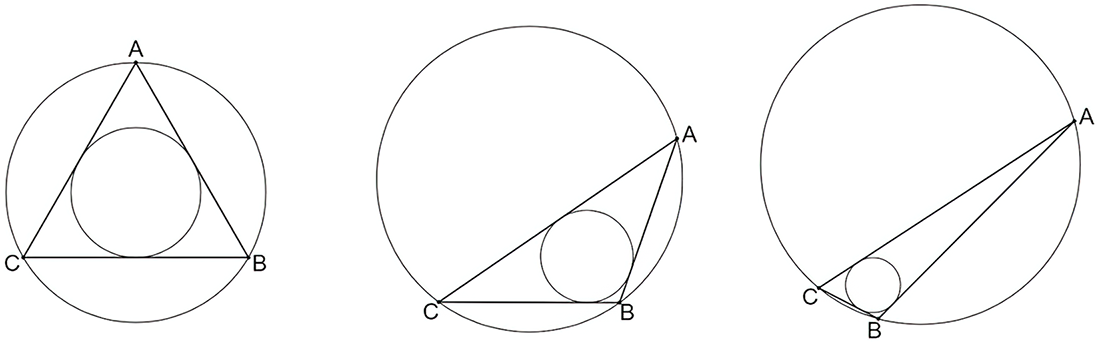
See how the Rin/Rout value decreases as a triangle approaches degeneracy. section 2.2.2
