liveBook · Manning

Ring oscillator

As explained in Hacking Cryptography

An electronic oscillator formed by connecting an odd number of inverting logic gates in a ring.

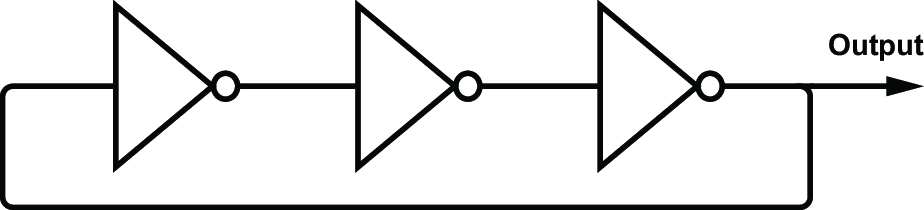
A ring oscillator connects an odd number of NOT gates in a loop. The resulting feedback makes the output alternate between two voltage levels, producing oscillation. In true random number generators, the design samples jitter in those clock signals rather than measuring clock drift directly. section 2.2.1

Treat ring-oscillator-based randomness as an implementation-sensitive physical source:

  • Use an odd number of inverting gates to form the ring and sustain oscillation. section 2.2.1
  • Rely on signal jitter as the entropy-related phenomenon, analogous to clock-drift methods. section 2.2.1
  • Expect careful engineering: physical power-supply noise and remote co-resident applications can influence processor behavior. section 2.2.1
Figure 2.6 A ring oscillator
figure

Figure 2.6 provides the supplied visual representation of a ring oscillator. section 2.2.1

How Hacking Cryptography covers it

How deep it goes
Defines the gate-loop construction and jitter rationale, while emphasizing implementation pitfalls rather than detailed circuit analysis.
Examples
Uses an odd ring of NOT gates and Figure 2.6 to illustrate oscillation between two voltage levels.
What you can do after
Evaluate ring-oscillator-based RNGs for implementation sensitivity and susceptibility to physical or remote influence.
How it connects
Connects true random number generators with clock jitter, NOT gates, clock drift, and power-supply noise.

Related concepts

This explainer was generated by Manning's knowledge graph from the text of Hacking Cryptography. The section links point to the parts of the book it draws on.