A customer-facing FAQ bot may need only an AI disclosure—until a feature starts assessing payment-plan eligibility from claims and payment data. Classification follows intended purpose, so a change in what the system does can change its category even when its underlying technology stays the same. section 7.2
Use the system’s purpose and actual deployment to guide classification:
- Determine whether the system qualifies as an AI system. section 7.2
- Check whether the use case is prohibited, then whether it is high-risk. Being in a sector such as insurance does not by itself make a system high-risk; the specific use matters. section 7.2
- Determine what transparency rules apply to other systems, and document the reasoning against the Act and available guidance. section 7.2
When ClaimAssist changes category
ClaimAssist V1 gave predefined FAQ answers and did not use claims data or affect underwriting, so it was classified as limited risk and required a clear AI disclosure. Adding payment-plan eligibility decisions based on claims history and payment data changed its classification to a high-risk category. section 7.2
Reassess when monitoring reveals new input or output types, tool calls, user groups, or downstream decisions outside the approved purpose. Technical teams and legal counsel should make the high-risk call together; keep the supporting technical evidence in a shared repository with a named owner. section 7.2 section 7.4.2
Figure 7.3 Classification and role decision tree. The tree produces a risk classification output
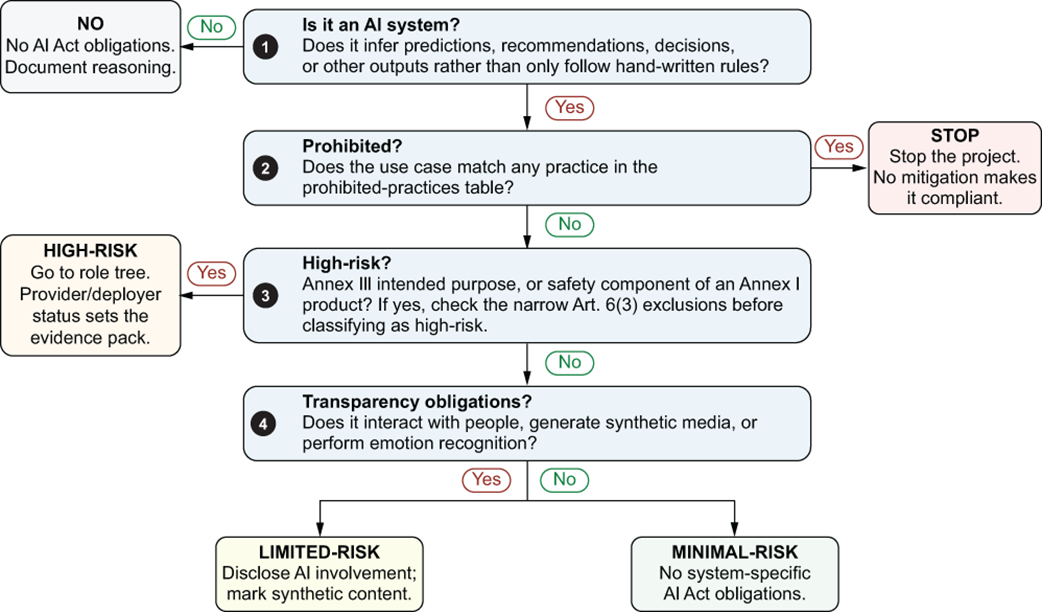
Use the decision tree to navigate classification checks and the resulting risk category. section 7.2
