A risk matrix classifies threats by likelihood and potential severity, helping investors identify which scenarios deserve attention first. It turns uncertain events into explicit portfolio questions and possible actions. section 7.1.3 section 7.7
Use a matrix as a practical review workflow:
- List plausible scenarios, such as another pandemic, new trade wars, an anti-AI movement, or rising energy prices. section 7.1.3
- Estimate each scenario’s likelihood and potential harm, recognizing that personal assessments introduce uncertainty. section 7.1.3
- Review every position, assign risk ratings, and define what to do if the rating reaches a chosen threshold. section 7.1.3
- Prioritize high-severity risks and prepare for worst-case outcomes, while accepting that a matrix cannot identify every nonfinancial risk. section 7.1.3 section 7.7
Trade-war scenario
For a portfolio holding Coca-Cola, Apple, and Pfizer, assess an escalation of a United States–China trade war as possible. If research suggests marginal harm to Coca-Cola and Pfizer but critical harm to Apple, the matrix assigns Apple a high-risk rating and supports a predefined response. section 7.1.3
Figure 7.3 How to map risk in a matrix based on severity and likelihood. We commonly create strategies to meet risks with higher harm severity first to mitigate the effect once the consequences become unavoidable.
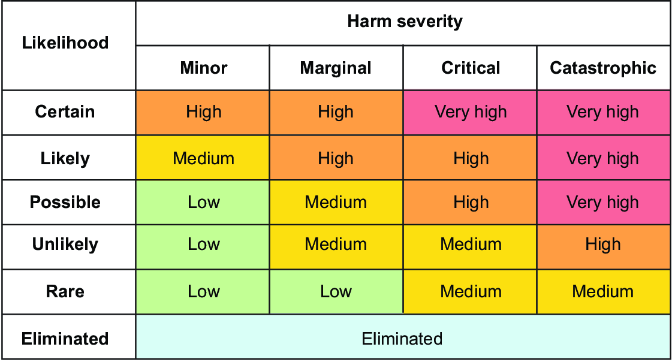
Inspect the severity-by-likelihood layout used to prioritize risks and mitigation strategies. section 7.1.3
