Risk tolerance is an investor’s willingness to accept uncertainty and potential losses in exchange for possible returns. It helps determine where an investor belongs on the risk–reward curve and supports choosing an appropriate stock–bond allocation. section 2.5
Robo-advisors commonly estimate risk tolerance with roughly 6–12 questions, assign points to the answers, and map the aggregate score to categories such as high, above average, average, below average, or low. Those categories are then connected to a stock–bond portfolio. section 2.5
Questionnaires use concrete choices to reveal how an investor responds to risk:
- Choose between guaranteed cash and increasingly uncertain prizes, such as $1,000 in cash, a 50% chance at $5,000, or a 5% chance at $100,000. section 2.5
- Respond to a job loss shortly before a once-in-a-lifetime vacation, choosing whether to cancel, reduce, continue, or extend the trip. section 2.5
- Decide how to invest an unexpected $20,000 among a bank account, high-quality bonds, or stocks. section 2.5
- Report comfort and experience with stocks or stock mutual funds, while related questions may be rephrased to check response consistency. section 2.5
Figure 2.5 A slider used to visualize the effects of changing the stock–bond mix
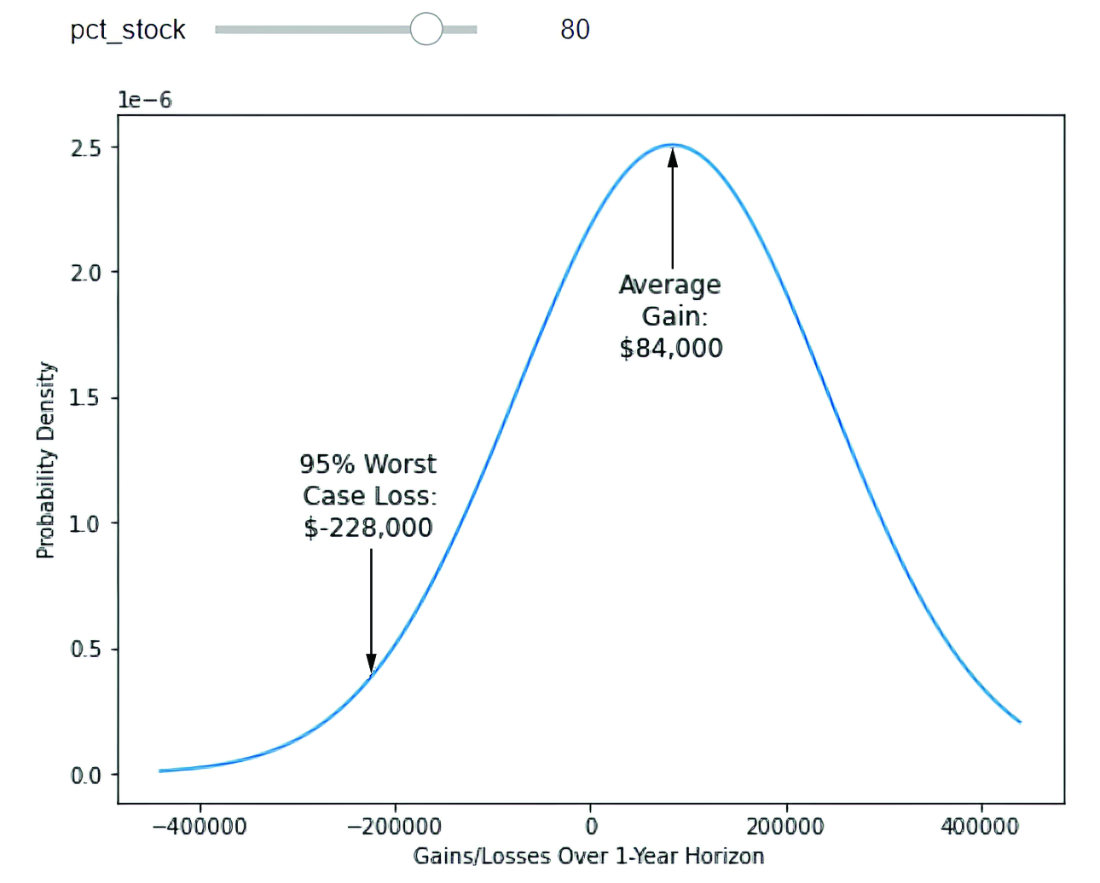
Use the stock–bond allocation slider to make the consequences of changing risk exposure visually concrete; the associated implementation estimates worst-case losses and gains. section 2.5

