A root node is the single topmost node in a hierarchy. It has no parent and separates into one or more branches that eventually end in leaf nodes. section 11.0 section 11.1.1
Represent the root in tabular data with a child value and an empty parent relationship. In the language dataset, “Languages” is the root; language families are its direct children. section 11.1.1
Build and use a root node in a D3 hierarchy:
- Declare parent-child relationships in CSV columns. section 11.1.1
- Configure d3-hierarchy stratify() with id and parentId accessors. section 11.1.1
- Generate the root, then access its descendants and leaves for visualization. section 11.1.1
Languages hierarchy
The root node “Languages” divides into Indo-European and Sino-Tibetan families, which subdivide into branches and then individual languages. A tree chart places this root at the left. section 11.3 section 11.1.1
Figure 11.2 A hierarchical visualization has one single root that separates into one or more branches. It ends with leaf nodes, which in this example are the languages.
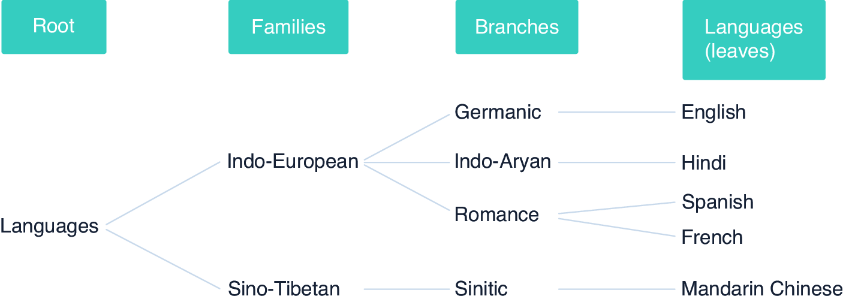
Use the diagram to see how one root separates into branches and ends with leaf nodes. section 11.0




