liveBook · Manning

Rootful mode

As explained in Podman in Action: Secure, rootless containers for Kubernetes, microservices, and more

A rootful container is a container whose engine or processes run with host-level root privileges.

Rootful mode runs Podman or container processes with host-level root privileges. Unlike rootless operation, it can configure host networking devices and firewall rules, but a breakout threatens the host and other workloads. section 6.0 section 6.2.3

Rootful Podman uses native Linux overlay mounts by default and CNI plugins for container networking. These privileges support advanced networking, but they enlarge the security boundary. section 6.2.2 section 6.2.3

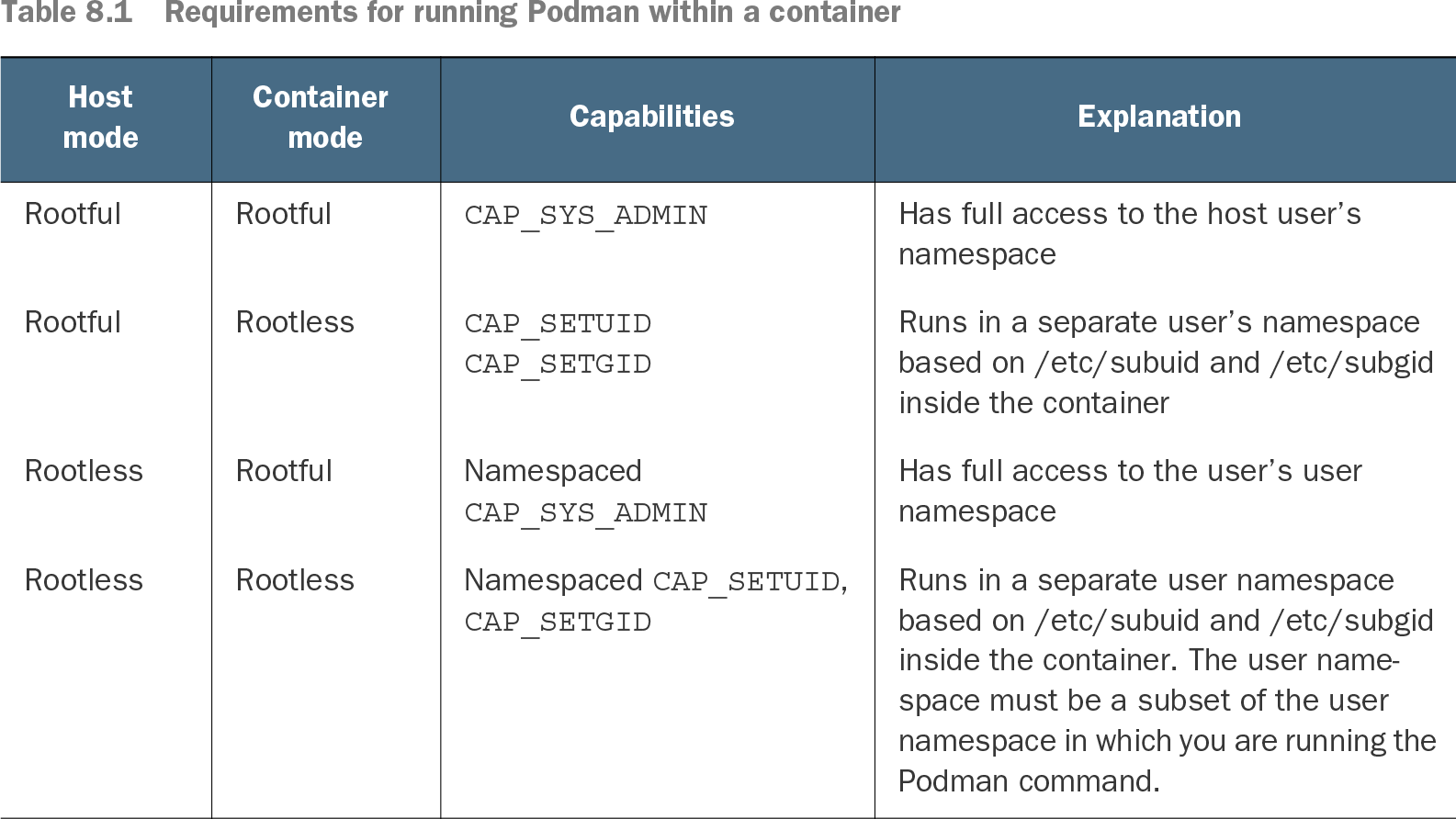
Running Podman inside another container exposes the capability requirements:

  • Use CAP_SYS_ADMIN for rootful Podman inside a container; --privileged supplies the capability needed to mount filesystems. section 8.4.1
  • Use a privileged Kubernetes container for equivalent rootful execution. section 8.4.2
  • Prefer rootless containers, dropped capabilities, read-only mode, or separated user namespaces when root privileges are unnecessary. section 11.5.1

Run rootful Podman inside a container

podman run --privileged quay.io/podman/stable podman version section 8.4.1

Figure 6.1 Multiple users’ workloads sharing the same daemon running as root is inherently insecure.
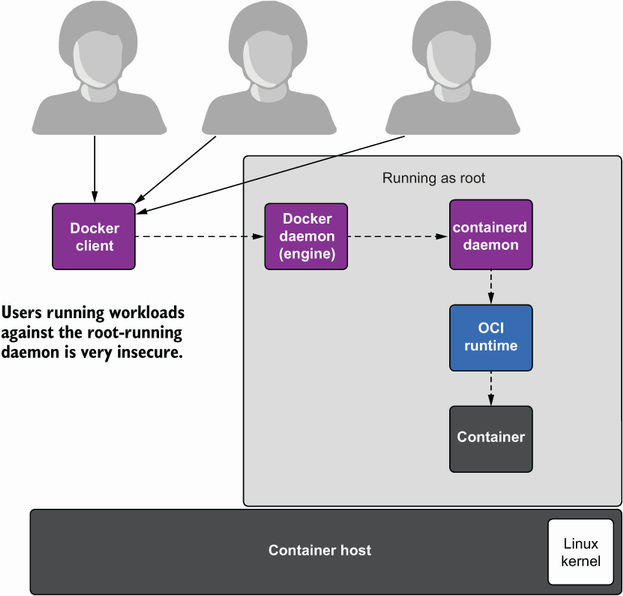
Compare the insecure shared root-running daemon model with independent user spaces. section 6.0

Table 8.1 Requirements for running Podman within a container (view table figure)

Host mode

Container mode

Capabilities

Explanation

Rootful

Rootful

CAP_SYS_ADMIN

Has full access to the host user’s namespace

Rootful

Rootless

CAP_SETUIDCAP_SETGID

Runs in a separate user’s namespace based on /etc/subuid and /etc/subgid inside the container

Rootless

Rootful

Namespaced CAP_SYS_ADMIN

Has full access to the user’s user namespace

Rootless

Rootless

Namespaced CAP_SETUID, CAP_SETGID

Runs in a separate user namespace based on /etc/subuid and /etc/subgid inside the container. The user namespace must be a subset of the user namespace in which you are running the Podman command.

Inspect host and container mode combinations with their required Linux capabilities. section 8.4

How Podman in Action: Secure, rootless containers for Kubernetes, microservices, and more covers it

How deep it goes
Explains rootful storage, networking, nested-container capabilities, and security tradeoffs, but defers complete daemon and namespace internals.
Examples
Demonstrates nested rootful Podman with --privileged and privileged Kubernetes YAML configuration.
What it assumes
Assumes basic Podman commands and Linux permissions, then develops capabilities, namespaces, storage mounts, and container networking.
What you can do after
Operate/configure rootful Podman in nested containers or Kubernetes while selecting required capabilities and recognizing security costs.
How it connects
Connects rootful mode to rootless containers, Linux namespaces, capabilities, overlay storage, CNI plugins, and Kubernetes.

Related concepts

This explainer was generated by Manning's knowledge graph from the text of Podman in Action: Secure, rootless containers for Kubernetes, microservices, and more. The section links point to the parts of the book it draws on.