A route constraint restricts which URL path segments can match an endpoint. Default values, optional segments, and catchall segments broaden matching; constraints narrow it. Put a colon and constraint name after a segment variable, such as `{first:int}`. A request whose value fails the constraint does not match that route. section 13.2.5
Constrain two segments
In Program.cs, map a GET endpoint with `app.MapGet("{first:int}/{second:bool}", async context => { foreach (var kvp in context.Request.RouteValues) await context.Response.WriteAsync($"{kvp.Key}: {kvp.Value}\n"); });`. After restarting ASP.NET Core, `/100/true` matches and exposes both route values. `/apples/oranges` has two segments but matches neither constraint, so the request continues to the terminal middleware. section 13.2.5
Choose constraints for the values an endpoint can handle, then test the boundaries:
- Use built-in constraints such as `alpha`, `bool`, `int`, `guid`, and numeric types. Constraints for locale-sensitive types match invariant-culture formats, not localized ones. section 13.2.5
- Stack constraints on one variable: `{first:alpha:length(3)}/{second:bool}` matches `/dog/true`, but not `/dogs/true`. All constraints on a segment must be satisfied. section 13.2.5
- Use `regex(...)` when a segment must match a specified set of values; the capital endpoint demonstrates this with a country segment. section 13.2.5
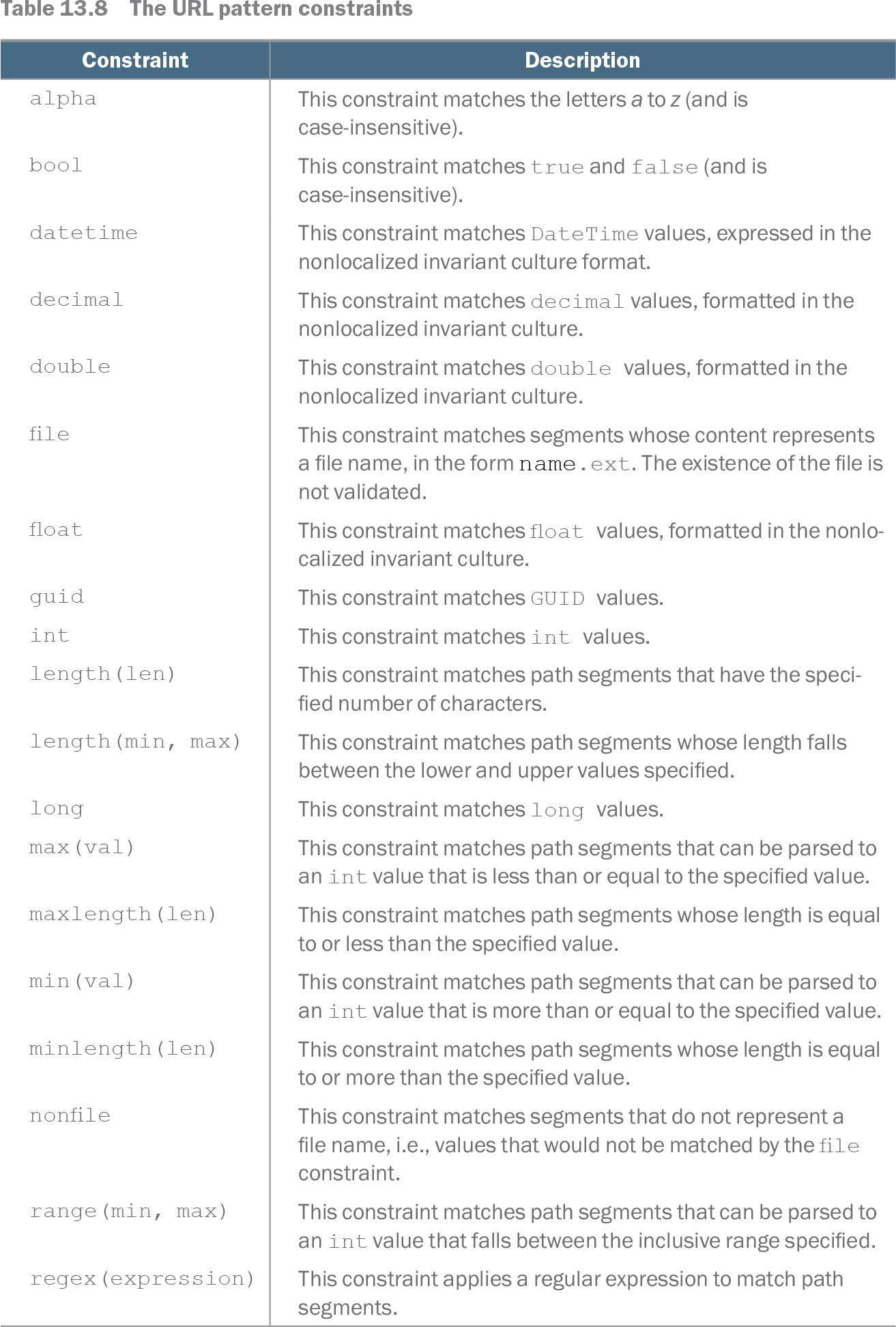
Table 13.8 The URL pattern constraints (view table figure)
| Constraint |
Description |
|---|---|
| alpha |
This constraint matches the letters a to z (and is case-insensitive). |
| bool |
This constraint matches true and false (and is case-insensitive). |
| datetime |
This constraint matches DateTime values, expressed in the nonlocalized invariant culture format. |
| decimal |
This constraint matches decimal values, formatted in the nonlocalized invariant culture. |
| double |
This constraint matches double values, formatted in the nonlocalized invariant culture. |
| file |
This constraint matches segments whose content represents a file name, in the form name.ext. The existence of the file is not validated. |
| float |
This constraint matches float values, formatted in the nonlocalized invariant culture. |
| guid |
This constraint matches GUID values. |
| int |
This constraint matches int values. |
| length(len) |
This constraint matches path segments that have the specified number of characters. |
| length(min, max) |
This constraint matches path segments whose length falls between the lower and upper values specified. |
| long |
This constraint matches long values. |
| max(val) |
This constraint matches path segments that can be parsed to an int value that is less than or equal to the specified value. |
| maxlength(len) |
This constraint matches path segments whose length is equal to or less than the specified value. |
| min(val) |
This constraint matches path segments that can be parsed to an int value that is more than or equal to the specified value. |
| minlength(len) |
This constraint matches path segments whose length is equal to or more than the specified value. |
| nonfile |
This constraint matches segments that do not represent a file name, i.e., values that would not be matched by the file constraint. |
| range(min, max) |
This constraint matches path segments that can be parsed to an int value that falls between the inclusive range specified. |
| regex(expression) |
This constraint applies a regular expression to match path segments. |
The built-in constraint table helps select a constraint and check its matching format. section 13.2.5
Constraints also affect route selection: a constrained segment takes precedence over an unconstrained segment variable. They do not guarantee a unique match. With `{number:int}` and `{number:double}`, `/23.5` matches the double route, but `/23` matches both and causes an ambiguous-route exception. Prefer making routes more specific with a literal segment or constraint. If overlap cannot be removed, set endpoint `Order`; the lowest value takes precedence. That workaround requires adding configuration through `RouteEndpointBuilder`. section 13.1.5 section 13.3.2