Row convolution adds a narrow temporal convolution over unidirectional RNN outputs in Deep Speech 2. It approximates the benefits of bidirectional context while retaining low latency for streaming: unlike bidirectional RNNs, it does not require future inputs before making predictions. section 4.4.1
Figure 4.5 Left: DS2 architecture used to train on English and Mandarin speech. The authors vary the number of convolutional layers from 1 to 3 and the number of recurrent layers from 1 to 7. Right: structure of the RNN model from the first Deep Speech paper [45]. Used with permission granted by one of the authors (Awni Hannun).
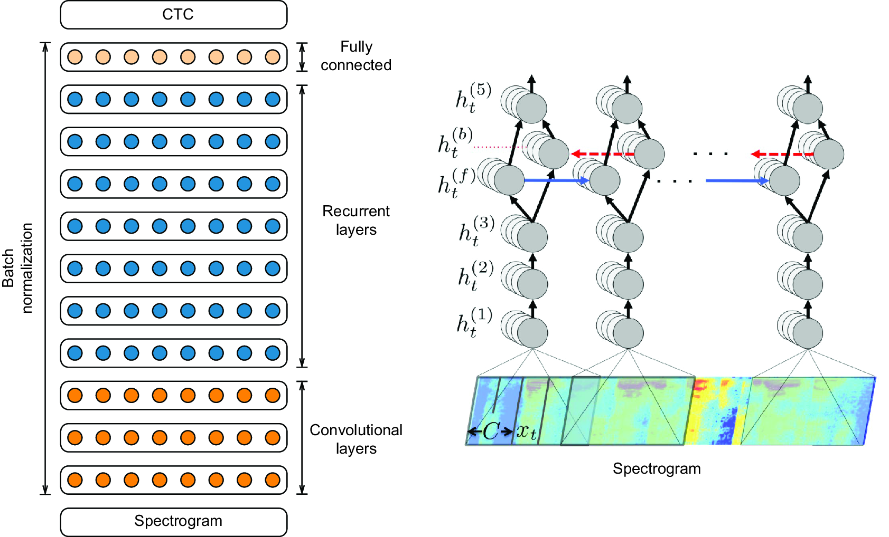
Use the architecture diagram to locate row convolution within Deep Speech 2’s convolutional and recurrent stack. section 4.4.1
