The RSTP synchronization mechanism lets RSTP-enabled switches coordinate neighboring ports so eligible ports reach forwarding rapidly instead of waiting for spanning-tree timers. section 15.2
Understand the transition and its limits:
- A newly enabled RSTP port starts in discarding. Alternate and backup ports remain there to prevent Layer 2 loops. section 15.2.2
- A root or designated port immediately enters forwarding when synchronization succeeds, normally across a full-duplex point-to-point link. section 15.2.2 section 15.3
- Synchronization does not work across shared half-duplex links or with devices using ordinary STP, such as a router, PC, or STP switch. section 15.2.2 section 15.3
- When synchronization fails, the port follows the timer-based path: 15 seconds discarding, 15 seconds learning, then forwarding. section 15.2.2
Full-duplex switch link
Two switches connected by a full-duplex link use the point-to-point link type. A root or designated port can synchronize with its neighbor and move directly from discarding to forwarding. A half-duplex link through a hub cannot use this mechanism and behaves like a standard STP link. section 15.3 section 15.2.2
Figure 15.3 An RSTP port can transition to the forwarding state in one of two ways. If the RSTP sync mechanism succeeds, the port immediately transitions to the forwarding state. If the RSTP sync mechanism fails, the port transitions from discarding to learning to forwarding, like a regular STP port.
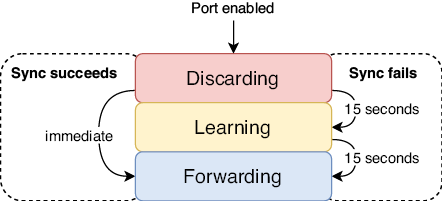
Compare the immediate forwarding path with the discarding-to-learning-to-forwarding fallback. section 15.2.2
