A recommendation can predict what a customer will buy without changing what they buy. Predictive accuracy therefore does not establish that recommendations increase sales. section 3.3.1
When accuracy has no effect
Suppose a mobile app predicts every purchase correctly, including a customer buying bread. If the customer would have bought the bread anyway, the recommendation has no causal effect. Comparing users who receive recommendations with users who do not can reveal whether sales actually increase. section 3.3.1
Evaluate a recommendation as an intervention:
- Treat showing a specific item as a treatment and compare the user's response with the response when it is not shown. section 3.3.1
- Use an A/B test to estimate the average treatment effect of recommendations rather than relying only on cross-validation accuracy. section 3.3.1
Figure 3.12 Graph of a pure recommender system that does not influence the customer. This system may predict customer behavior accurately, but it does not affect their actions.
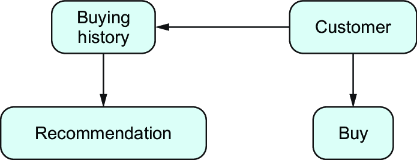
Use the causal graph to distinguish a recommender that predicts customer behavior from one that changes it; the corresponding standard graph is also available. section 3.3.1
