Adaptive imitation describes performance that remains effective as conditions change, rather than an appearance of competence limited to familiar cases. Because flexible behavior can persist while the underlying mechanism differs, it can be difficult to distinguish imitation from ability. section 9.1.1 section 9.6
Chess and language models
A chess engine can adapt to unfamiliar positions without playing as a human does. Large language models likewise adapt across topics, formats, styles, and tasks, though hallucinations and rule breaking remain limitations. section 9.1.1 section 9.1.1
Figure 9.1 Brittle and adaptive imitation. A brittle system may appear capable when tested on familiar cases, but its performance collapses when the situation changes. In chess, this would be a system that plays well only in familiar positions. An adaptive system continues to perform in unfamiliar cases, making the difference between imitation and ability harder to draw.
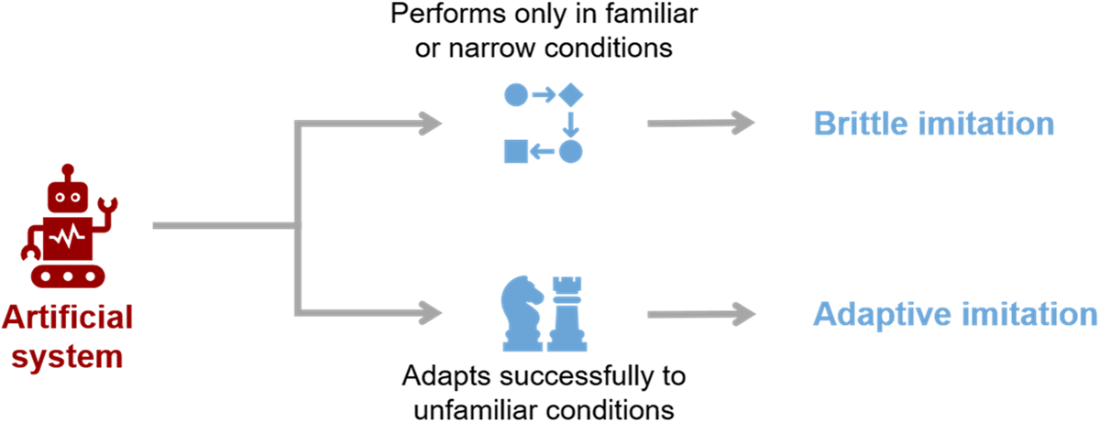
Contrasts performance that collapses in unfamiliar cases with performance that adapts to them. section 9.1.1
