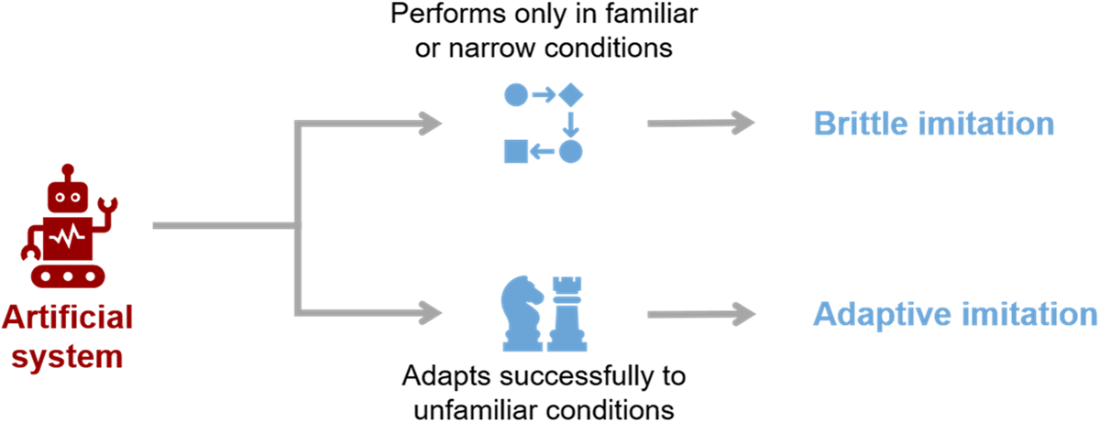
Brittle imitation produces the appearance of skill only under a narrow set of conditions; when those conditions change, performance collapses. The difference between appearance and ability becomes clear when the imitation is tested beyond familiar boundaries. section 9.1.1 section 9.6
A decorative plant can look real at a distance but not on close inspection. ELIZA, a 1960s chatbot based on simple pattern matching, seemed to understand while conversation stayed within its controlled boundaries, then failed beyond them. Adaptive imitation, by contrast, continues to perform when situations change; a chess engine can respond to unfamiliar positions without playing as a human does. section 9.1.1 section 9.1.1
Large language models are described as well past brittle imitation: their responses adapt across topics, formats, styles, and tasks. Yet flexibility does not settle whether their behavior amounts to intelligence; their mechanisms remain different, and failures such as hallucinations and rule breaking persist. section 9.1.1 section 9.6
Figure 9.1 Brittle and adaptive imitation. A brittle system may appear capable when tested on familiar cases, but its performance collapses when the situation changes. In chess, this would be a system that plays well only in familiar positions. An adaptive system continues to perform in unfamiliar cases, making the difference between imitation and ability harder to draw.
Compare how brittle and adaptive imitation respond when familiar conditions change. section 9.1.1
