liveBook · Manning

Scalar field

As explained in Geometry for Programmers

A scalar field is a function that assigns a scalar value to each point in a domain.

A scalar field assigns one scalar, or real number, to every point in a domain. Unlike a vector field, it records a value rather than a direction and magnitude. In geometric modeling, the domain is ℝᴺ and the codomain is ℝ. section 2.4.2

Signed distance fields

A signed distance function (SDF) is a scalar field that gives every point in space its distance from a curve or surface. The sign adds geometric meaning: points outside a body receive positive values, while points inside receive negative values. SDF representations support efficient CAD operations and can help turn a solid model into a hollow shell. section 2.4.2
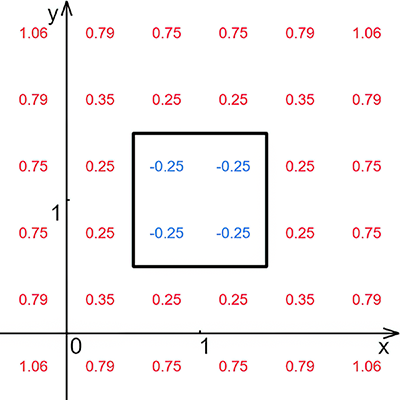
Figure 2.26 An SDF illustration
02-26

Use the SDF illustration to connect a scalar value at each point with inside/outside geometry. section 2.4.2

How Geometry for Programmers covers it

How deep it goes
Defines scalar fields by domain and codomain, then illustrates signed distance values without developing their implementation mechanics.
Examples
Uses signed distance functions, positive outside values, negative inside values, and hollow-shell modeling as concrete examples.
What it assumes
Builds on functions, domains, codomains, and geometric modeling terminology.
What you can do after
Evaluate/understand scalar fields as pointwise real-valued functions and recognize signed distance fields in geometric modeling.
How it connects
Connects scalar fields to functions, vector fields, distance functions, geometric transformations, CAD, surfaces, and triangle meshes.

Related concepts

This explainer was generated by Manning's knowledge graph from the text of Geometry for Programmers. The section links point to the parts of the book it draws on.