A vector field assigns an M-dimensional vector to every point in N-dimensional space. Its domain is ℝN and its codomain is ℝM, so the two dimensions may differ. Imagine a field as a collection of geometric pointers: each pointer describes a direction and magnitude attached to a location. section 2.4.2
A vector field differs from a geometric transformation. A transformation moves points directly; a vector field describes where points could move and can also carry information such as colors in an unrelated color space. A continuous field contains vectors between the regularly spaced arrows shown in an illustration, even when those vectors are not drawn. section 2.4.2
From field to deformation
When a vector field specifies how each location should translate, it becomes a deformation field. Applying it to a square can move, bend, and stretch different points by different amounts, making the idea useful for 3D modeling. section 2.4.2
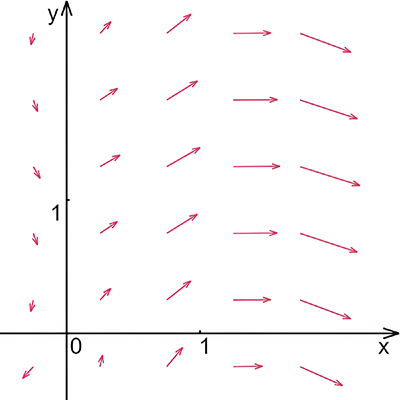
Use the continuous-field illustration to read the arrows as sampled views of vectors that exist throughout the plane. section 2.4.2
Figure 2.25 The vector field from figure 2.24 used as a deformation field. It moves, bends, and stretches the square.
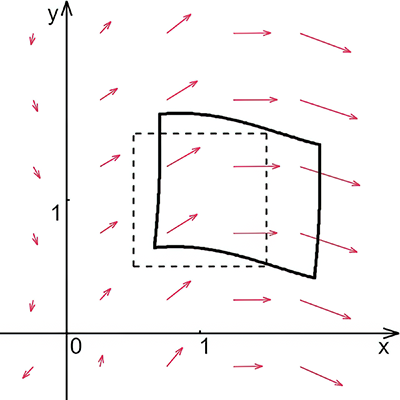
Use the deformation-field illustration to connect local vector directions and magnitudes with a model’s resulting movement, bending, and stretching. section 2.4.2
