A continuous deformation field assigns a vector to every point in space. Each vector specifies how far and in what direction that point should move, so applying the field can move, bend, or stretch a geometric object. section 2.4.2
A deformation field is useful because it:
- Represents a transformation whose movement depends on position rather than applying one identical displacement everywhere. section 2.4.2
- Supports 3D modeling by deforming complete objects and generating families of related surfaces. section 2.4.2 section 8.0
- Uses spatial or multivariable interpolation to create smooth, controllable variation between specified displacement vectors. section 8.0 section 8.3.4
Randomly deforming mushrooms
Place eight control points around a mushroom model and assign each a small random displacement. Inverse-distance interpolation estimates a displacement at every model point; adding the resulting vectors to the x, y, and z coordinates produces a subtly different mushroom. section 8.3.4
Figure 2.25 The vector field from figure 2.24 used as a deformation field. It moves, bends, and stretches the square.
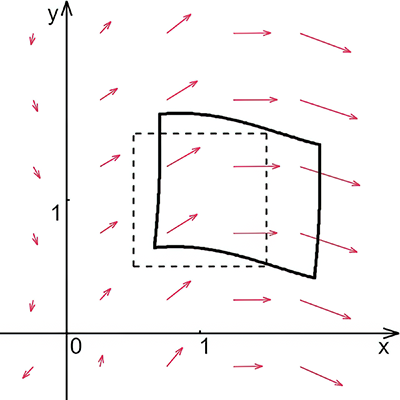
Visualizes how a vector field becomes a deformation field that moves, bends, and stretches a square. section 2.4.2
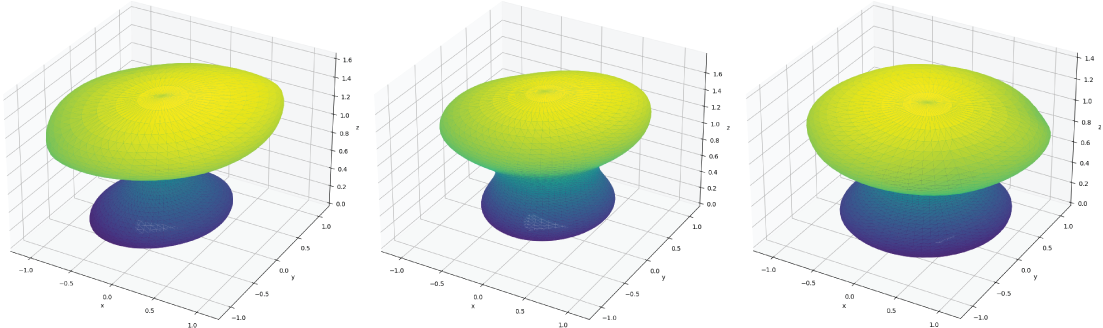
Shows the practical result: randomly generated mushrooms with randomized deformation. section 8.3.4
