When several indexes expand to roughly 10 TB, horizontal scaling adds nodes instead of enlarging existing machines. Elasticsearch forms a larger cluster and shares the capacity across those nodes. section 14.3.2 section 3.6.2
Scaling out means starting additional virtual machines as Elasticsearch nodes and joining them to the existing cluster. The distributed engine then distributes data across the expanded environment. section 3.6.2
Use horizontal scaling to:
- Increase read throughput or indexing performance by adding nodes. section 14.1
- Handle growing data or query loads without relying only on larger machines. section 3.6
- Provision additional capacity through virtual machines and infrastructure-as-code tools such as Terraform, Ansible, or Chef. section 3.6.2
- Plan capacity carefully because shard sizing, memory requirements, data volume, and business demands affect the required cluster size. section 14.1 section 14.3.2
Adding nodes for multiple indexes
A five-node cluster with 400 GB per node provides about 2 TB. To support about 10 TB for multiple indexes, add 20 nodes, creating a 25-node cluster with the same 400 GB per node. This contrasts with vertical scaling, which would increase each existing server to 2 TB. section 14.3.2
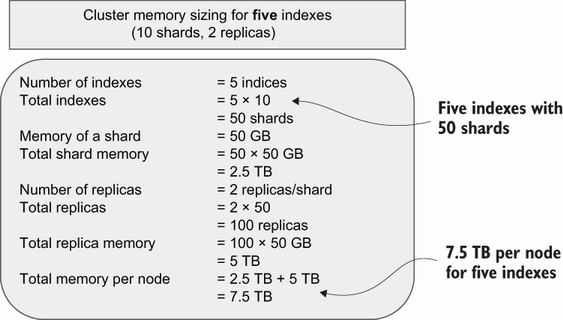
Use the figure to inspect how memory requirements grow when multiple indexes, shards, and replicas are planned together. section 14.3.2












