A second-level domain (SLD) is a domain directly beneath a top-level domain (TLD) in the hierarchical DNS tree. For example, google is an SLD beneath com, forming google.com. Each SLD can contain further subdomains, such as www.google.com. section 3.1.3
Figure 3.3 The DNS hierarchy. All domains are under the root domain, represented by “.”. Under the root domain, there are various top-level domains. Under each top-level domain, there are various second-level domains. The “google” domain, a subtree under the “com” top-level domain, is highlighted.
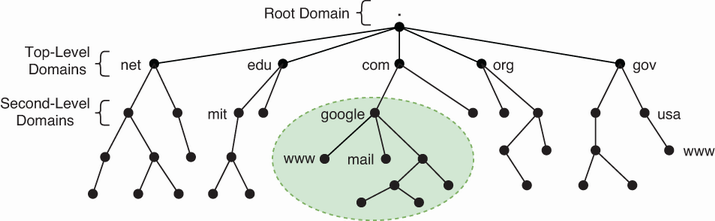
Use the DNS hierarchy diagram to locate the root domain, TLDs, and SLDs step by step. section 3.1.3
Key points:
- The root domain is represented by a dot; TLDs such as com appear beneath it. section 3.1.3
- An SLD is itself a subdomain of its TLD and can contain third-level and lower-level subdomains. section 3.1.3
- A fully qualified domain name identifies the complete hierarchy, as in www.google.com. section 3.3
