A top-level domain (TLD) is a domain directly beneath the DNS root domain, represented by a single dot. Common examples include com, net, and org. section 3.1.3 section 3.3
DNS organizes names as a tree: the root contains TLDs, each TLD contains second-level domains such as google under com, and those domains can contain further subdomains. section 3.1.3
Use these relationships to read a DNS name:
- com is the TLD in google.com. section 3.1.3
- google is a second-level domain beneath the com TLD. section 3.1.3
- www in www.google.com is a lower-level name, not a TLD; www is a conventional server name rather than a technical requirement. section 3.1.3
Figure 3.3 The DNS hierarchy. All domains are under the root domain, represented by “.”. Under the root domain, there are various top-level domains. Under each top-level domain, there are various second-level domains. The “google” domain, a subtree under the “com” top-level domain, is highlighted.
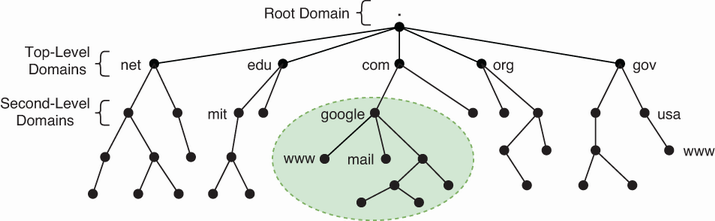
The hierarchy diagram places the root above TLDs and highlights google as a subtree beneath com. section 3.1.3
