The root domain is the unnamed top of the DNS hierarchy, conventionally written as a single dot (.). DNS organizes domains as a tree: top-level domains such as com sit below the root, followed by second-level domains and deeper subdomains. section 3.1.3
Use the root domain to interpret DNS names from the hierarchy’s top downward:
- The root domain has no name; its dot appears explicitly at the end of a fully qualified domain name (FQDN), although that dot is commonly omitted. section 3.3
- Top-level domains such as com, net, and org are directly below the root domain. section 3.1.3
- Recursive resolvers query root DNS servers first when locating the servers responsible for a relevant top-level domain. section 3.3
Reading a DNS name
In google.com., the final dot represents the root domain, com is the top-level domain, and google is the second-level domain. In www.google.com., www is a deeper subdomain. section 3.1.3 section 3.3
Figure 3.3 The DNS hierarchy. All domains are under the root domain, represented by “.”. Under the root domain, there are various top-level domains. Under each top-level domain, there are various second-level domains. The “google” domain, a subtree under the “com” top-level domain, is highlighted.
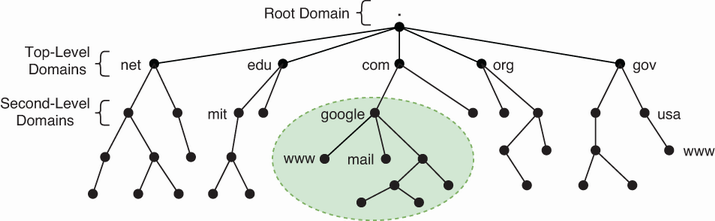
Visualizes the root domain above TLDs, second-level domains, and the highlighted google subtree. section 3.1.3
