A root DNS server sits at the top of the DNS hierarchy and guides iterative resolution when a recursive resolver lacks a cached answer. It does not normally return the requested IP address; instead, it refers the resolver to the relevant top-level domain (TLD) server. section 3.1.4
During resolution, the sequence is:
- A client sends a recursive query requesting a definite answer to its recursive resolver. section 3.3
- The recursive resolver sends an iterative query to a root server. section 3.1.4
- The root server refers the resolver to the server responsible for the queried TLD, such as com. section 3.1.4
- The TLD server then refers the resolver to the domain’s authoritative DNS server, which supplies the definitive record. section 3.3
Figure 3.4 Recursive and iterative DNS requests resolve a domain name. In step 1, PC1 attempts to access mail.google.com. Steps 2 and 9 are a recursive DNS exchange between PC1 and the 8.8.8.8 DNS server. Steps 3 through 8 are iterative DNS exchanges between 8.8.8.8 and other DNS servers. Step 10 is an HTTPS exchange between PC1 and mail.google.com.
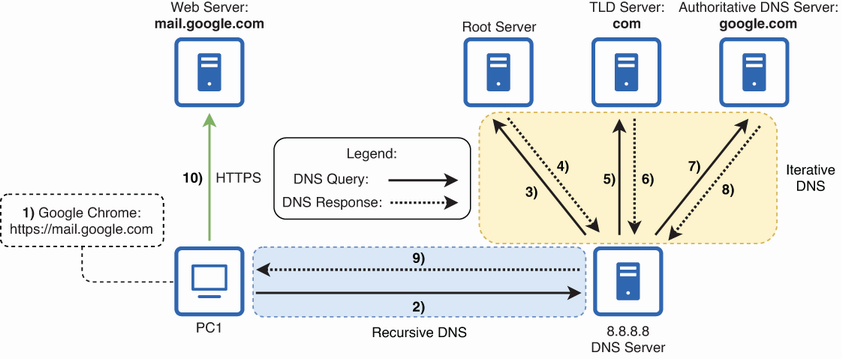
Follow the complete exchange: recursive requests connect the client and resolver, while iterative requests connect the resolver with root, TLD, and authoritative servers. section 3.1.4
