A TLD server manages a top-level domain such as .com. During iterative DNS resolution, it receives a query from a recursive resolver and returns a referral to the authoritative server for the requested domain rather than supplying the final address. section 3.1.4 section 3.3
The resolution sequence is:
- Receive an iterative query from the recursive resolver after the root server identifies the relevant TLD. section 3.1.4
- Return a referral identifying the authoritative DNS server for the domain, such as google.com under the com TLD. section 3.1.4
- Leave the definitive domain records and final answer to the authoritative server; caching may reduce or bypass later queries. section 3.3
Resolving mail.google.com
The recursive resolver 8.8.8.8 queries a root server, receives a referral to a .com TLD server, and then receives a referral to an authoritative server for google.com. That authoritative server supplies the definitive response, which 8.8.8.8 returns to the client. section 3.1.4
Figure 3.4 Recursive and iterative DNS requests resolve a domain name. In step 1, PC1 attempts to access mail.google.com. Steps 2 and 9 are a recursive DNS exchange between PC1 and the 8.8.8.8 DNS server. Steps 3 through 8 are iterative DNS exchanges between 8.8.8.8 and other DNS servers. Step 10 is an HTTPS exchange between PC1 and mail.google.com.
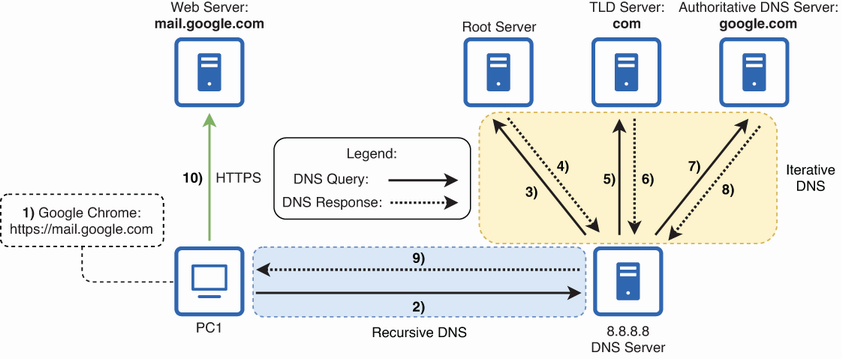
Trace the ten-step interaction from the client’s recursive exchange with 8.8.8.8 through iterative root, TLD, and authoritative-server queries. section 3.1.4
