A security information and event management (SIEM) system brings security data into one place. It collects logs and events from systems, applications, network devices, and security tools, then analyzes them to help analysts spot suspicious activity and investigate possible incidents. section 12.6.3 section 12.13
This matters because each server, workstation, and application keeps its own logs, often in different formats and locations. Centralizing those records gives analysts a clearer view of activity across the organization instead of forcing them to check each system separately. section 10.4.2 section 12.6.3
A SIEM's main jobs are:
- Collect and consolidate logs from multiple sources. section 12.6.3
- Correlate events—look at related records together and in time order—to identify suspicious patterns. section 10.4.2 section 5.3.2
- Generate alerts for analysts to investigate. An alert is a lead, not proof that an incident occurred: harmless activity can trigger a false positive, while a real incident can go undetected. section 12.6.3 section 5.3.2
Failed logins followed by success
Suppose an account has many failed login attempts, then a successful login. Viewed together, those records could suggest a brute-force attack. An analyst can define a correlation rule to alert on repeated failed logins in a short period. Reliable time order matters: if system clocks disagree, the records may appear in the wrong sequence. Network Time Protocol (NTP) helps keep their timestamps consistent. section 10.4.2
A SIEM chiefly supports visibility and detection; people often still decide how to respond. Security orchestration, automation, and response (SOAR) platforms complement it by coordinating and automating response actions across tools. section 12.6.3
Figure 12.13 Illustration of the setup of a SIEM architecture combining network IPS/IDS with host agents.
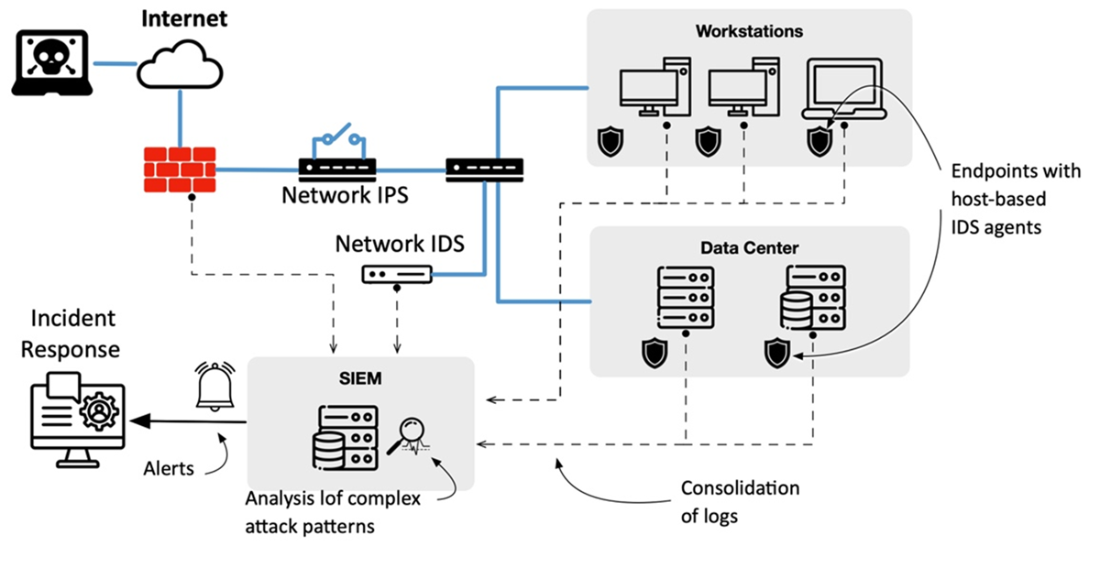
The architecture illustration shows how network intrusion detection or prevention systems and host agents can contribute to a SIEM setup. section 12.6.3

