Security training helps employees recognize threats, follow security policies, and report suspicious activity. Awareness training applies to everyone; job-specific training builds the skills needed for particular duties, such as secure coding for developers or system security measures for administrators. section 7.2
Run training as an ongoing risk-reduction program:
- Refresh awareness at least annually. Shorter, more frequent sessions can keep emerging threats visible. section 7.2
- Set targets for completion and comprehension, then track retraining and repeated failures rather than counting attendance alone. section 7.2.2
- Check behavior with phishing-identification assessments, incident simulations, phishing reports, and policy-violation trends. section 5.2.4
Interpreting a training dashboard
After an audit found employees struggling to recognize and respond to threats, an organization targeted 100% mandatory-training completion and a comprehension failure rate below 2%. Its later dashboard showed 100% completion and 1% failure. Those figures show participation and knowledge transfer; observed reporting and response behavior are still needed to judge practical effect. section 7.2.2 section 5.2.4
Figure 7.5 The left side shows the review of training and awareness metrics before implementing a comprehensive training program. The right side shows the improvements after implementing the training program.
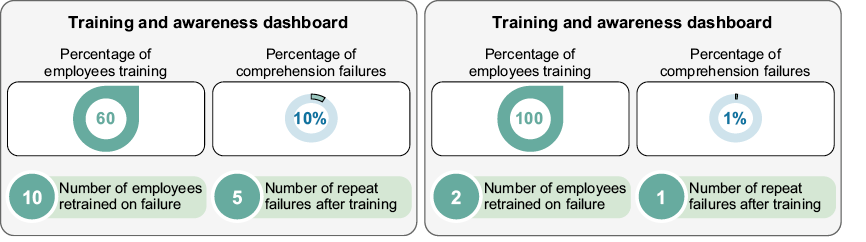
Compare the before-and-after awareness and training metrics to identify gains and measures that still need attention. section 7.2.2
Use the results to decide where to reinforce training, and keep reporting responsibilities clear. Following a breach that began with a phishing email, one institution paired organization-wide phishing training with MFA, stronger email filtering, and improved monitoring. section 3.2.6 section 9.5.1
