ChatGPT
ChatGPT is OpenAI’s conversational AI service, which lets users interact with generative AI models and related tools through natural-language prompts.

Starting Data Analytics with Generative AI and Python
A conversational generative-AI system developed by OpenAI that responds to user prompts with generated content.
- How it is used
- Supports data analytics through conversational prompting, code generation, interpretation, and text analysis.
- How deep it goes
- Demonstrates web and Python API workflows and evaluates sentiment results, while setting model architecture details aside.
- Examples
- Uses Portuguese customer reviews, delivery-time patterns, and an API-generated keyword list as practical examples.
- What you can do after
- Apply ChatGPT through its web interface or OpenAI API to assist with analytics, while checking outputs and protecting data.
Read how Starting Data Analytics with Generative AI and Python explains ChatGPT →

AI for Everyday IT
ChatGPT is OpenAI's conversational generative AI service for interacting with users through natural-language prompts and responses.
- How it is used
- Uses ChatGPT as a practical assistant for IT support, systems administration, research, and workplace communication.
- How deep it goes
- Works through contextual prompts and responses for troubleshooting and administration, emphasizing practical use rather than model internals.
- Examples
- Demonstrates a VPN ticket CSV analysis and a Bash script for comparing kernel versions across servers.
- What you can do after
- Apply it via ChatGPT to draft scripts, analyze support information, and research workplace questions while checking the results.
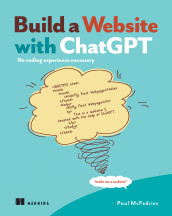
Build a Website with ChatGPT
ChatGPT is a conversational artificial-intelligence system that generates or transforms text and code in response to natural-language prompts.
- How it is used
- Turns plain-English requests into web-page code and helps develop page content.
- How deep it goes
- Defines GPT in plain language and works through prompting, saving, testing, and deployment without pursuing model internals.
- Examples
- Uses a Hello World prompt, a button-driven random-pun page, an online journal, and a photo gallery.
- What you can do after
- Build it from scratch: prompt for a simple web page, save its files, test it, revise the request, and deploy it.
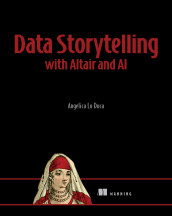
Data Storytelling with Altair and AI
ChatGPT is a generative AI conversational system that produces and transforms text from user prompts.
- How it is used
- Generates audience-tailored textual context, calls to action, and candidate next steps for data stories.
- How deep it goes
- Explains prompt structures, iterative refinement, and practical story cases, while deferring generative-AI fundamentals.
- Examples
- Uses homelessness subtitles, sports-investment titles, pet-campaign sharing options, hotel feasibility options, and population-policy sequencing.
- What you can do after
- Apply it through ChatGPT to draft and refine audience-specific chart text and investigate proposed next steps.
Read how Data Storytelling with Altair and AI explains ChatGPT →

Coding with AI
ChatGPT is a conversational generative-artificial-intelligence service that generates text and code in response to user prompts.
- How it is used
- Supports developers across software planning, implementation, testing, debugging, and documentation through conversational prompts.
- How deep it goes
- Explains prompt-driven design and development workflows with generated artifacts and review guidance, alongside a brief account of probabilistic text generation.
- Examples
- Demonstrates a TODO application plan, requirements for a practice-test application, and a Mermaid flowchart.
- What you can do after
- Apply ChatGPT to draft and refine software artifacts, then verify its output and make the final development decisions.

Introduction to Generative AI, Second Edition
ChatGPT is a conversational language-model system from OpenAI that generates responses to user prompts.
- How it is used
- Introduces conversational AI through a widely used interface for generating, summarizing, and explaining text.
- How deep it goes
- Surveys capabilities and limitations, connects them to high-level LLM training, and illustrates professional risks without implementation detail.
- Examples
- Illustrates use with a patient-communication script and a legal brief containing invented precedents.
- What you can do after
- Evaluate ChatGPT responses against reliable sources and recognize confidentiality risks when entering prompts.
Read how Introduction to Generative AI, Second Edition explains ChatGPT →

Data Analysis with LLMs
ChatGPT is a conversational artificial-intelligence service that lets users interact with OpenAI language models through natural-language messages.
- How it is used
- Supports data analysis either by processing supplied text directly or by turning natural-language requests into code for other tools.
- How deep it goes
- Walks through account access, conversation controls, text tasks, and a CSV upload; stops short of language-model internals.
- Examples
- Uses product reviews for text analysis and a review table for counting records by product category.
- What you can do after
- Apply it via the ChatGPT web interface to ask analysis questions, upload a CSV, and inspect generated code before relying on results.

Inside AI
ChatGPT is a conversational artificial-intelligence system that generates responses to natural-language prompts.
- How it is used
- Introduces accessible conversational generative AI for work and everyday tasks, including customer support and content creation.
- How deep it goes
- Explains word prediction and its limitations through factual and contextual failures, without implementation details.
- Examples
- Uses fabricated legal cases, repeated biographical questions, and a question about birds startled by a gunshot.
- What you can do after
- Evaluate ChatGPT responses by recognizing that fluent, confident answers can contain fabricated information or miss context.

Build Financial Software with Generative AI (From Scratch)
A conversational generative-AI system that responds to natural-language prompts and can generate text or code.
- How it is used
- Uses ChatGPT as a conversational assistant for financial-software exploration, coding, and debugging.
- How deep it goes
- Works through prompt refinement, generated code, and debugging, without explaining model internals.
- Examples
- Uses Check 21 summaries, a Python balance display, a transaction-retention bug, and an ACH parser.
- What you can do after
- Apply ChatGPT to refine prompts, generate and investigate code, and review results with tests and domain knowledge.
Read how Build Financial Software with Generative AI (From Scratch) explains ChatGPT →
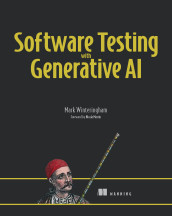
Software Testing with Generative AI
ChatGPT is a conversational artificial-intelligence system that generates responses to user prompts using language-model technology.
- How it is used
- Applies prompt-driven language generation to testing, development, UI automation, and exploratory understanding.
- How deep it goes
- Explains prompt use through worked code and testing examples, but stops short of treating generated output as reliable without verification.
- Examples
- Uses conversational prompts, Java API-client generation, Selenium page objects, contact-form checks, code comments, and visual process models.
- What you can do after
- Apply it via focused prompts to draft code, improve automated checks, and clarify unfamiliar systems while independently validating results.
Read how Software Testing with Generative AI explains ChatGPT →
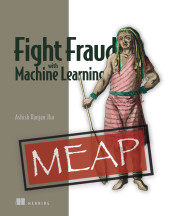
Fight Fraud with Machine Learning
ChatGPT is a conversational artificial-intelligence system based on generative language models.
- How it is used
- Applies ChatGPT to classify phishing emails, explain decisions, and improve missed patterns through prompting.
- How deep it goes
- Explains language modeling and autoregressive next-word prediction, then demonstrates classification, explanation, and one-shot prompting rather than model construction.
- Examples
- Uses next-word completions, a fraud conversation, and an email from a nonexistent domain corrected through one-shot prompting.
- What you can do after
- Apply it via ChatGPT to classify phishing emails, inspect explanations, and revise prompts after a missed pattern.
Read how Fight Fraud with Machine Learning explains ChatGPT →
Grokking AI Applications
ChatGPT is a conversational AI system built on generative language models and trained to respond to human users.
- How it is used
- Uses generative language modeling to support meaningful conversations with human users.
- How deep it goes
- Explains three training stages and application-level extensions, but stops short of detailed model internals.
- Examples
- Uses GPT sentence completion, human-guided refinement, reinforcement learning, and chatbot conversations as teaching examples.
- What you can do after
- Evaluate ChatGPT as a layered system rather than as an isolated language model.

LLMs in Production
ChatGPT is a conversational AI service that provides an interactive interface for generating responses from large language models.
- How it is used
- Positions ChatGPT as an accessible interface for turning large language models into a widely usable product.
- How deep it goes
- Explains its product-level significance and reliability challenge, but stops short of describing model architecture or training internals.
- Examples
- Uses difficult user questions, rapid adoption, and the contrast between a one-time demo and a service serving millions.
- What you can do after
- Evaluate generative-AI products by accessibility, reliability at scale, and the gap between prototypes and dependable services.
The Complete Obsolete Guide to Generative AI
A version of the ChatGPT conversational artificial-intelligence service released in 2022.
- How it is used
- Uses ChatGPT to clarify specific programming problems, draft workplace writing, and generate task-focused starting points.
- How deep it goes
- Explains prompt specificity through concrete questions and generated code, while deferring broad instruction to tutorials and hands-on practice.
- Examples
- Uses Python list iteration, 4K-to-1080p video conversion, an after-action report, and an essay with fabricated references.
- What you can do after
- Apply it via ChatGPT by framing focused prompts, using outputs as drafts, and verifying code, facts, and references.
Read how The Complete Obsolete Guide to Generative AI explains ChatGPT →
Troubleshooting Java, Second Edition
ChatGPT is a conversational AI system that generates natural-language responses to user prompts.
- How it is used
- Uses ChatGPT as an early aid for generating troubleshooting ideas and understanding Java application behavior.
- How deep it goes
- Introduces prompting and investigative value but stops short of detailed prompt design, validation methods, or implementation internals.
- Examples
- Uses an AI prompt describing a problem to identify possible troubleshooting starting points.
- What you can do after
- Apply it via ChatGPT to generate initial investigation ideas and accelerate understanding of application behavior.
Read how Troubleshooting Java, Second Edition explains ChatGPT →
How Large Language Models Work
A conversational artificial-intelligence service developed by OpenAI that generates responses to natural-language prompts.
- How it is used
- Frames ChatGPT as a practical generative-AI system for consumers, developers, and business decision makers.
- How deep it goes
- Defines ChatGPT and its surrounding terms in plain language, while deferring detailed treatment of pretraining and transformers.
- Examples
- Uses a haiku prompt and input-output examples spanning text, images, audio, and numbers.
- What you can do after
- Understand what ChatGPT is, what it can and cannot do, and when related systems may be unsuitable.
Grokking Relational Database Design
ChatGPT is a conversational generative artificial intelligence service that produces responses to user prompts.
- How it is used
- Accelerates database design by supporting requirements, entity design, SQL generation, verification, and visualization.
- How deep it goes
- Explains prompting practices and a complete workflow, but stops short of guaranteeing correct answers or replacing design verification.
- Examples
- Uses a spaceship-manufacturer database, structured prompts, generated MySQL code, and dbdiagram.io diagrams.
- What you can do after
- Build database designs from requirements and communicate them through verified text, SQL, and diagrams.
Read how Grokking Relational Database Design explains ChatGPT →

Elasticsearch in Action, Second Edition
ChatGPT is a conversational artificial-intelligence system that generates human-like text in response to user prompts.
- How it is used
- Supports conversational assistance for writing, planning, summarization, code analysis, data modeling, and technology comparison.
- How deep it goes
- Explains conversational behavior and next-word prediction, but stops short of describing transformer internals or deployment details.
- Examples
- Uses travel itineraries, legal summaries, self-help plans, code analysis, data models, technology comparisons, and complaint letters.
- What you can do after
- Apply it via conversational prompts to generate text and support varied planning, analysis, summarization, and writing tasks.
Read how Elasticsearch in Action, Second Edition explains ChatGPT →
Learn AI-Assisted Python Programming, Second Edition
ChatGPT is a conversational artificial-intelligence system that generates responses to natural-language prompts using large language models.
- How it is used
- Supports questions, writing, programming, and other knowledge-focused tasks through natural-language interaction.
- How deep it goes
- Defines ChatGPT’s broad role and contrasts it with Copilot, but does not explain model internals or implementation.
- Examples
- Uses questions, essays, MBA examinations, Python programs, prompt patterns, and creative persona requests as examples.
- What you can do after
- Apply it to answer questions, write essays, explore creative prompts, and support beginner programming tasks.
Read how Learn AI-Assisted Python Programming, Second Edition explains ChatGPT →

Machine Learning for Tabular Data: XGBoost, Deep Learning, and AI
ChatGPT is a conversational AI system based on large language models that generates responses to user prompts.
- How it is used
- Supports practical tabular-data analysis, from textual feature engineering and visualization to interpretation and reporting.
- How deep it goes
- Demonstrates end-to-end analytical tasks but reports weaker tabular prediction performance than fully supervised models.
- Examples
- Uses CSV files, textual columns, matplotlib commands, regular expressions, charts, tables, and generated analytical reports.
- What you can do after
- Apply it via the Advanced Data Analytics API to analyze CSV data and reproduce results with generated Python code.
Read how Machine Learning for Tabular Data: XGBoost, Deep Learning, and AI explains ChatGPT →

Modern Angular
ChatGPT is an artificial-intelligence conversational system that generates responses from natural-language prompts.
- How it is used
- Uses prompted generation to accelerate mock-data creation, dependency mocking, and Angular unit-test drafting.
- How deep it goes
- Demonstrates concrete prompts and generated TypeScript, but stops short of replacing developer judgment in service mocking.
- Examples
- Uses typed time-off requests, a service mock, generated component tests, and DOM assertions as working examples.
- What you can do after
- Apply it via ChatGPT to generate test fixtures, Observable-based service mocks, and initial Angular component tests.
Also covered in
- AI-Powered Developer: Build software with ChatGPT and Copilot
- A Pythonic Adventure: From Python basics to a working web app
- Regular Expression Puzzles and AI Coding Assistants
- Data Without Labels
- Machines that ThinkIn early access (MEAP)
- Lead Developer Career Guide
- Causal AI
- Vibe EngineeringIn early access (MEAP)
- Learn AI Data EngineeringIn early access (MEAP)
- WordPress Power Toolkit: Harness AI to build next-level websites
What to know first
- language modelA language model is a computational model that represents patterns in linguistic sequences to assign probabilities, predict, generate, or evaluate language.
- PythonPython is a high-level, general-purpose, dynamically typed programming language with readable syntax and support for multiple programming paradigms.
- artificial intelligenceArtificial intelligence is the field of computing concerned with creating systems that perform tasks associated with intelligence, such as learning, reasoning, perception, and decision-making.
- conversational aiConversational AI is artificial intelligence that enables software systems to interpret user input and interact with users through natural-language dialogue.
Related concepts
- conversational aikind of · Conversational AI is artificial intelligence that enables software systems to interpret user input and interact with users through natural-language dialogue.
- language modelkind of · A language model is a computational model that represents patterns in linguistic sequences to assign probabilities, predict, generate, or evaluate language.
- GPT modeluses · A GPT model is a generative, autoregressive Transformer language model in the family developed by OpenAI.
- promptused by · A prompt is text or other input supplied to an AI model to provide instructions, context, or other information that guides its response or generated output.
- GPT-4uses · GPT-4 is a multimodal large language model developed by OpenAI that processes text and image inputs and generates text.
- RLHFused by · Reinforcement learning from human feedback is a model-training approach that uses human evaluations or preferences as feedback to optimize model behavior.
Questions about ChatGPT
What is ChatGPT?
ChatGPT is OpenAI’s conversational AI service, which lets users interact with generative AI models and related tools through natural-language prompts.
Which Manning books explain ChatGPT?
Starting Data Analytics with Generative AI and Python, AI for Everyday IT, Build a Website with ChatGPT, Data Storytelling with Altair and AI, Coding with AI, Introduction to Generative AI, Second Edition, Data Analysis with LLMs, Inside AI and 13 more.
What should I know before learning ChatGPT?
Manning books that teach ChatGPT usually introduce language model, Python, artificial intelligence and conversational ai first.
What is ChatGPT a kind of?
ChatGPT is a kind of conversational ai. Conversational AI is artificial intelligence that enables software systems to interpret user input and interact with users through natural-language dialogue.
What is ChatGPT also called?
ChatGPT is also called Chat GPT.
These guides are generated from the text of Manning books by Manning's knowledge graph and link to the sections they draw on. The full books are available on liveBook and at manning.com.