Selection decides which candidate solutions get to reproduce and which remain in a genetic algorithm’s population. Parent selection chooses individuals to produce offspring through crossover and mutation. Survivor selection chooses the individuals that form the next population. Keeping these decisions separate helps clarify why a promising parent is not necessarily guaranteed a place in the next generation. section 7.2.3 section 7.3.5
Start with a population whose candidates have fitness values. A selection method favors promising solutions, but how strongly it favors them matters. High selective pressure can reduce diversity quickly and cause premature convergence on a suboptimal solution. Preserve enough opportunity to explore alternatives rather than repeatedly choosing only the current best. section 7.2.3 section 7.3.3
Parent-selection approaches illustrate different ways to favor fitness:
- Elitism selects the fittest individuals for reproduction and can carry top performers into the next generation. Preserving more of them reduces the succeeding population’s diversity. section 7.3.3
- Fitness-proportionate selection assigns each individual a selection probability proportional to its fitness, then samples randomly. Roulette-wheel selection is one implementation. section 7.3.3
Selecting ticket-pricing candidates
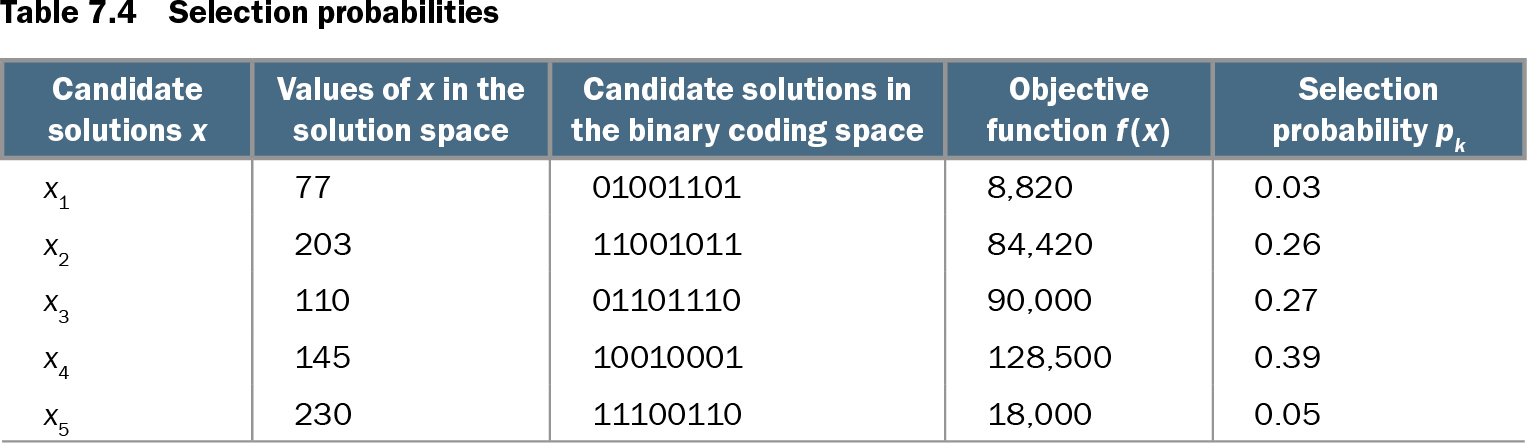
Five candidate pricing solutions have a combined fitness of 329,740. The strongest candidate has fitness 128,500, giving it a roulette-wheel selection probability of about 0.39; the next strongest has fitness 90,000 and probability about 0.27. Neither is certain to be drawn: fitness changes the odds rather than fixing the result. section 7.3.3
Table 7.4 Selection probabilities (view table figure)
| Candidate solutions x |
Values of x in the solution space |
Candidate solutions in the binary coding space |
Objective function f(x) |
Selection probability pk |
|---|---|---|---|---|
| x1 |
77 |
01001101 |
8,820 |
0.03 |
| x2 |
203 |
11001011 |
84,420 |
0.26 |
| x3 |
110 |
01101110 |
90,000 |
0.27 |
| x4 |
145 |
10010001 |
128,500 |
0.39 |
| x5 |
230 |
11100110 |
18,000 |
0.05 |
Compare each ticket-pricing candidate’s fitness with its fitness-proportionate selection probability. section 7.3.3
After reproduction, survivor selection fills the next population from existing individuals and new offspring. Options include random selection, removing the oldest individuals, fitness-proportionate replacement, elitist selection across old and new candidates, and tournaments. A generational genetic algorithm replaces the whole population with offspring; a steady-state algorithm generates fewer offspring and may replace only some existing individuals. Choose a method with both solution quality and population diversity in mind. section 7.3.5 section 7.3.4