Self-consistency improves reasoning reliability by generating multiple diverse answers instead of accepting one greedy Chain-of-Thought path, then selecting the answer that appears most consistently across outputs. Majority voting is a common selection method. section 6.4.5 section 6.4.6
A practical self-consistency workflow is:
- Provide few-shot examples and a clearly structured reasoning prompt. section 6.4.5
- Sample multiple reasoning paths rather than taking the greedy path. section 6.4.6
- Compare the candidate answers and choose the most consistent result, often through majority voting. section 6.4.6
- Monitor accuracy, consistency, and grounding, and cross-check important results with trusted external sources. section 13.2.6
Arithmetic reasoning
For a word problem such as calculating the number of computers added from Monday through Thursday, provide a few-shot reasoning format, generate several candidate solutions, and select the answer shared by the largest number of valid paths. This approach targets arithmetic, commonsense, and logical reasoning tasks. section 6.4.5 section 6.4.6
Self-consistency reduces noise and encourages multiple viewpoints, but it does not establish factual correctness. Unreliable candidates can still agree, so critical decisions require review, grounding, and safeguards against overreliance. section 6.4.6 section 13.2.6
Figure 6.16 Self-consistency sampling
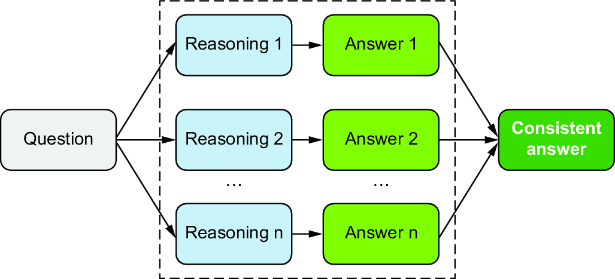
Use the sampling diagram to visualize how multiple reasoning paths produce candidate answers and how consistency guides selection. section 6.4.6





