liveBook · Manning

Self-consistency

As explained in The Art of AI Product Development

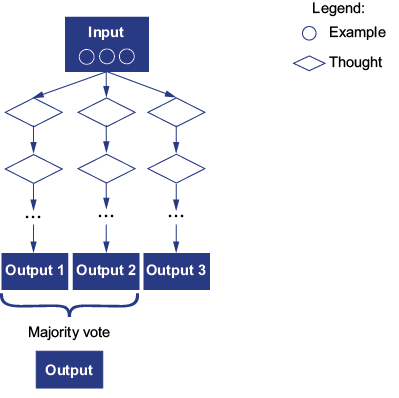
Self-consistency is a prompting technique that samples multiple reasoning or response paths and selects or synthesizes the answer supported by the most consistent results.

Self-consistency turns language-model randomness into a selection process: generate several reasoning or response paths, then retain the result best supported by agreement or evaluation. It helps extend prompting beyond simple tasks toward complex, creative, or multistep outputs. section 6.3 section 6.3.2

Choose the selection method according to the output:

  • Use majority voting for categorical answers with a definite ground truth, such as sentiment analysis. section 6.3.2
  • Ask the model to score open-ended outputs, or apply a stronger external check when one exists. section 6.3.2
  • Budget time and resources for repeated calls, and monitor prompts continuously against real-world interactions. section 6.3.2 section 6.5

Content-generation experiment

Generate three LinkedIn posts announcing a May 25, 2025, webinar about complying with the EU AI Act. Ask the model to critically score each post from 1 to 10 and return the results as a JSON array. section 6.3.2

Figure 6.6 Schema of self-consistency prompting
A diagram of a flowchart

AI-generated content may be incorrect.

Use the schema to visualize repeated generation followed by output selection. section 6.3.2

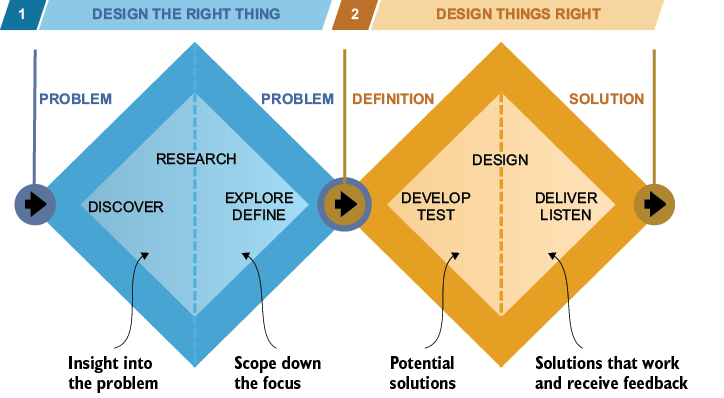
Figure 6.7 Double diamond model of a creative process
A diagram of a design process

AI-generated content may be incorrect.

Use the double diamond to frame broad creative exploration followed by convergence on a preferred solution. section 6.3.2


How The Art of AI Product Development covers it

How deep it goes
Explains repeated sampling, voting, self-scoring, and testing, but stops short of implementation detail beyond temperature settings.
Examples
Demonstrates sentiment-analysis voting, unit-test validation, and scored LinkedIn-post variants for an EU AI Act webinar.
What it assumes
Assumes familiarity with basic prompting and introduces repeated model calls as a response to few-shot prompting limits.
What you can do after
Apply it by generating multiple prompt outputs and choosing through voting, scoring, or a confidence-building external check.
How it connects
Connects self-consistency with few-shot prompting, chain-of-thought prompting, reflection prompts, majority voting, and the double diamond model.

Also explained in

Compare how 6 books explain self-consistency →

Related concepts

This explainer was generated by Manning's knowledge graph from the text of The Art of AI Product Development. The section links point to the parts of the book it draws on.



