Self-healing CI turns a failed pipeline from a passive error report into an active diagnosis and repair proposal. Instead of returning only a failed test and exit code, it explains the likely cause and suggests a targeted correction, reducing blind agent iterations. section 10.4.2
The build system and coding agent become bidirectional collaborators: CI interprets failures, supplies relevant context, and proposes a verified fix. The approach is useful only when the underlying tests are reliable; otherwise it accelerates misleading feedback and creates trust debt. section 10.4.2 section 10.2.5
Apply guardrails before increasing automation:
- Stabilize tests before enabling autonomous merges or review-skipping green-bucket policies; noisy tests make fast infrastructure produce wrong answers faster. section 10.4.2
- Cap repair attempts at roughly one or two rounds. More iterations often indicate flakiness or a task beyond the agent's capability, making further compute wasteful. section 10.4.2
- Prefer actionable diagnostics over generic failure strings, and verify proposed fixes before treating them as merge-safe. section 10.4.2
From failure report to repair proposal
A generic report says that auth_integration_test failed with exit code 1. A self-healing system instead identifies a 401 from shared-auth in the staging mock and proposes the configuration change needed to correct it. That context can turn 47 guessing iterations into a one-iteration fix. section 10.4.2
Figure 10.3 Build Metadata Becomes a Live Context Layer.
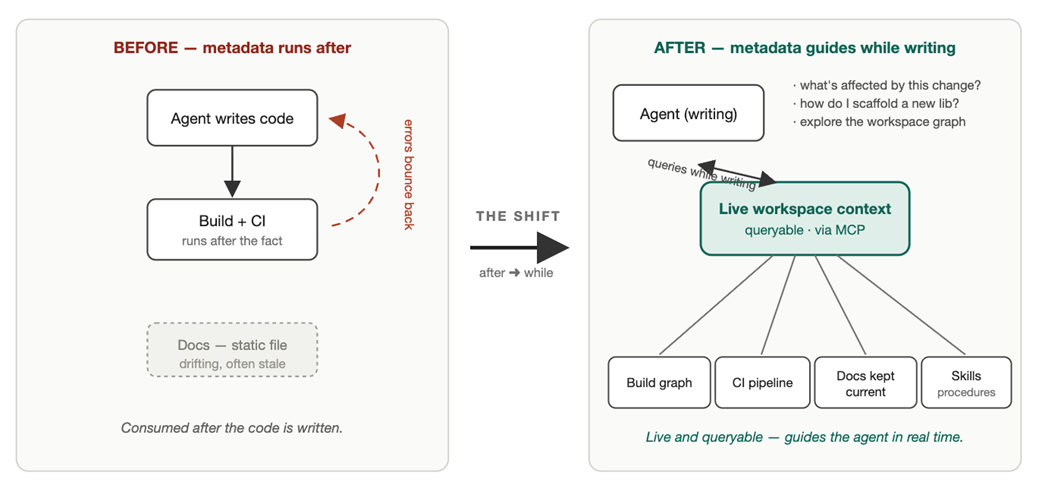
Build metadata can become a live context layer, connecting agents to the project graph, CI pipeline, current documentation, and workspace procedures. section 10.2.5
