Self-publishing lets an author control a book’s topic, schedule, updates, rights, and production instead of relying on a traditional publisher. That freedom comes with responsibility: the author must handle tedious details and bring or create an audience. section 17.4 section 17.7
Use this decision checklist before committing:
- Choose self-publishing when the topic is highly specialized, the potential reader base is small or uncertain, and publishers may see insufficient commercial potential. section 17.4.5
- Check whether a known newsletter, project, company, or personal reputation can provide an initial audience and word-of-mouth momentum. section 17.4.6
- Plan for focused, linear work, but explicitly assign yourself production, review, distribution, marketing, and other tasks that experts would otherwise handle. section 17.4.3 section 17.7
- Research specific self-publishing options by reading author experiences and asking authors about tools, timelines, distribution, review, and production. section 17.4.7
Build interest before launch
Publish the first chapters as blog posts to test whether the idea resonates, develop material incrementally, and decide whether a complete book is the right format. section 17.3.2
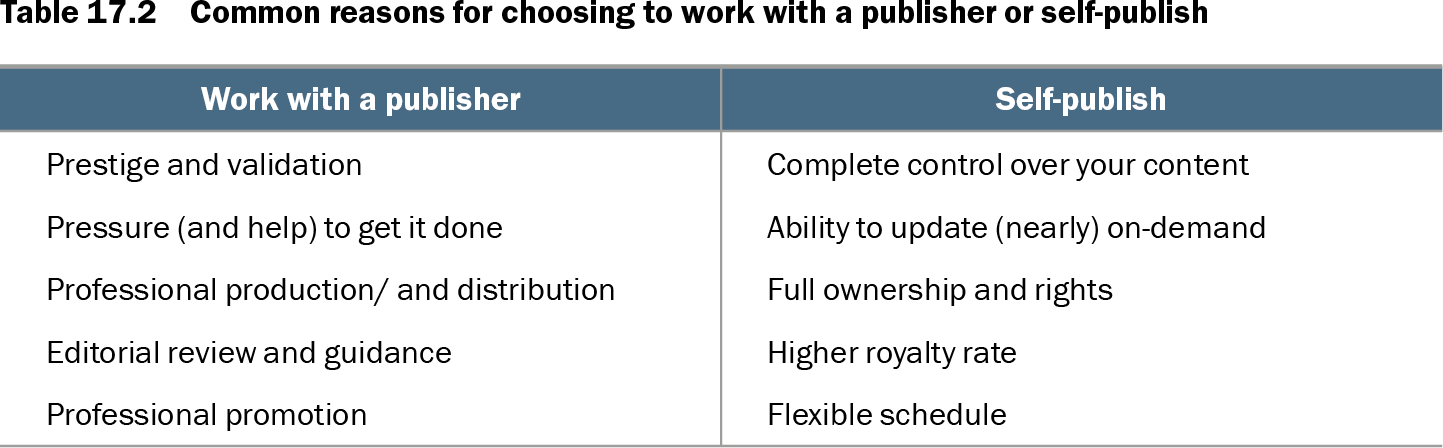
Table 17.2 Common reasons for choosing to work with a publisher or self-publish (view table figure)
| Work with a publisher |
Self-publish |
|---|---|
| Prestige and validation Pressure (and help) to get it done Professional production/ and distribution Editorial review and guidance Professional promotion |
Complete control over your content Ability to update (nearly) on-demand Full ownership and rights Higher royalty rate Flexible schedule |
Compare self-publishing with working through a publisher across control, updates, ownership, royalties, schedule, production, distribution, review, and promotion. section 17.4