A semantic gap occurs when an input and a relevant target express related ideas in different ways. In retrieval, a short, underspecified query may lack the vocabulary and detail of the document that answers it. section 7.1
Because the query and document can occupy distant regions of embedding space, direct vector search may miss a relevant document even when it is in the corpus. The problem is especially acute without labeled query-document pairs to adapt retrieval to a domain’s vocabulary. section 7.1
A short query, a detailed document
A search for “COVID-19 anxiety rates” may miss a paper titled “A Longitudinal Study on the Mental Health Impacts of the COVID-19 Pandemic, Focusing on Increased Incidence of Generalized Anxiety Disorder.” section 7.1
HyDE addresses this mismatch by having an LLM generate a semantically plausible hypothetical document, then retrieving by document-to-document similarity. The generated passage guides retrieval; retrieved documents provide factual grounding. section 7.0
Figure 7.1 With query–document mismatch, the query embedding lies far from the cluster of relevant documents, which is why direct embedding retrieval underperforms.
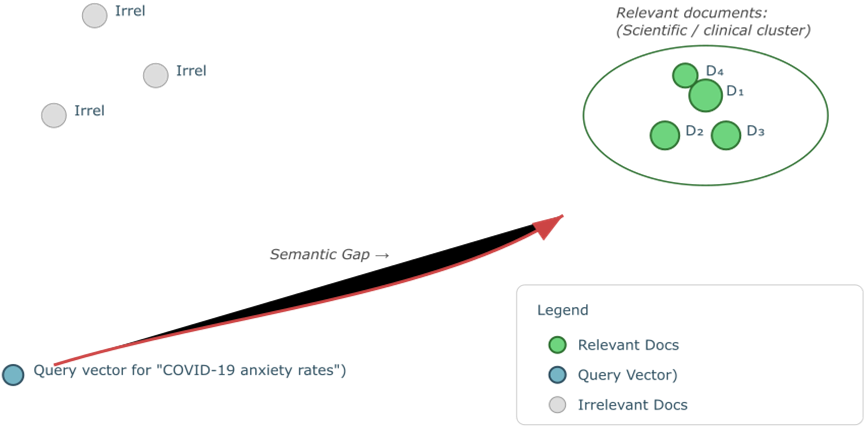
The figure shows the query embedding separated from the cluster of relevant documents, illustrating why direct embedding retrieval can underperform. section 7.1

