liveBook · Manning

Semantic Kernel

As explained in AI Agents in Action

Semantic Kernel is an open-source Microsoft software development kit for building AI applications that orchestrate language-model capabilities, plugins, and related services.

Semantic Kernel (SK) is Microsoft’s open-source SDK for building AI applications and agents. It orchestrates plugins, functions, language-model services, and chat interfaces so agents can act beyond conversation. section 5.3 section 5.8

Use SK to organize several kinds of agent capability:

  • Define semantic functions that encapsulate prompt templates and execute them against a language model. section 5.3.1
  • Wrap executable code and APIs as native functions, then combine them with semantic functions in layered execution stages. section 5.8
  • Manage multiple plugins through a chat interface or agent, while consuming or publishing compatible OpenAI plugin definitions. section 5.3

Connect a chat service

Install SK in a Python workspace, create a kernel, load OpenAI or Azure OpenAI settings, register a chat-completion service, and execute a prompt as a semantic function. The same approach can expose an API through a GPT interface and make it available to chat or agent users. section 5.3.1 section 5.5

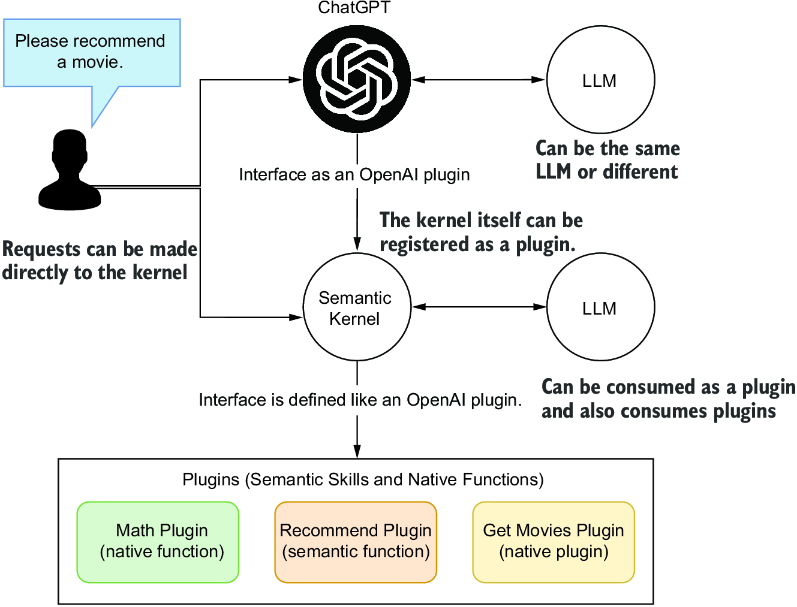
Figure 5.5 How the Semantic Kernel integrates as a plugin and can also consume plugins
figure

Trace how SK can operate as a plugin, consume other plugins, and coordinate them behind a chat or agent interface. section 5.3


How AI Agents in Action covers it

How deep it goes
Demonstrates installation, service registration, semantic-function execution, plugin composition, and GPT-interface construction, while focusing on actions rather than memory or planning.
Examples
Uses OpenAI or Azure OpenAI chat completion, TMDB API integration, temperature conversion, weather, creative writing, meal planning, and news plugins.
What it assumes
Assumes a configured Python workspace and service credentials, while teaching semantic functions, native functions, and plugins from their basic roles.
What you can do after
Build agent actions by installing SK, registering language-model services, creating functions, combining plugins, and exposing APIs through chat interfaces.
How it connects
Connects OpenAI function calling, plugins, semantic functions, native functions, GPT interfaces, chat interfaces, memory, and planning.

Also explained in

Compare how 3 books explain Semantic Kernel →

Related concepts

This explainer was generated by Manning's knowledge graph from the text of AI Agents in Action. The section links point to the parts of the book it draws on.
