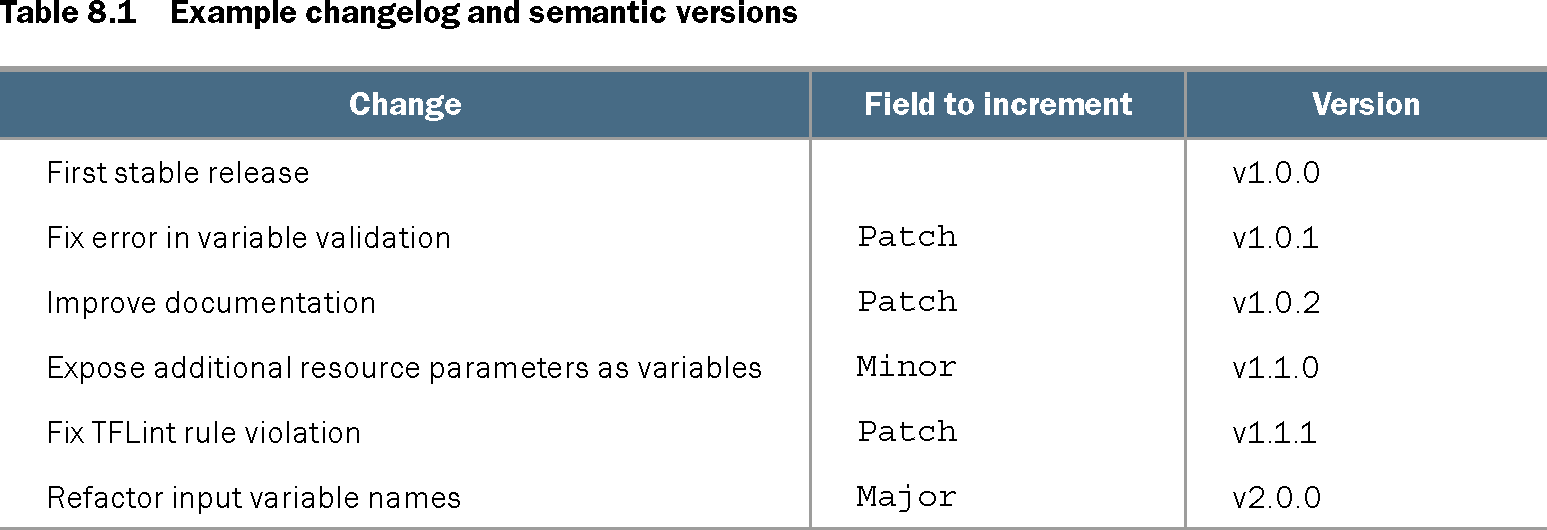
Semantic versioning labels releases as vMajor.Minor.Patch so users can estimate upgrade risk. Patch releases fix bugs, minor releases add backward-compatible features, and major releases indicate backward-incompatible change. section 8.1.1
Apply the version fields as follows:
- Start a stable module at v1.0.0. section 8.1.1
- Increment Patch for bug fixes or documentation improvements, such as v1.0.1 and v1.0.2. section 8.1.1
- Increment Minor and reset Patch when adding features, such as v1.1.0. section 8.1.1
- Increment Major and reset the other fields when backward compatibility breaks, such as v2.0.0. section 8.1.1
Constrain Terraform module upgrades
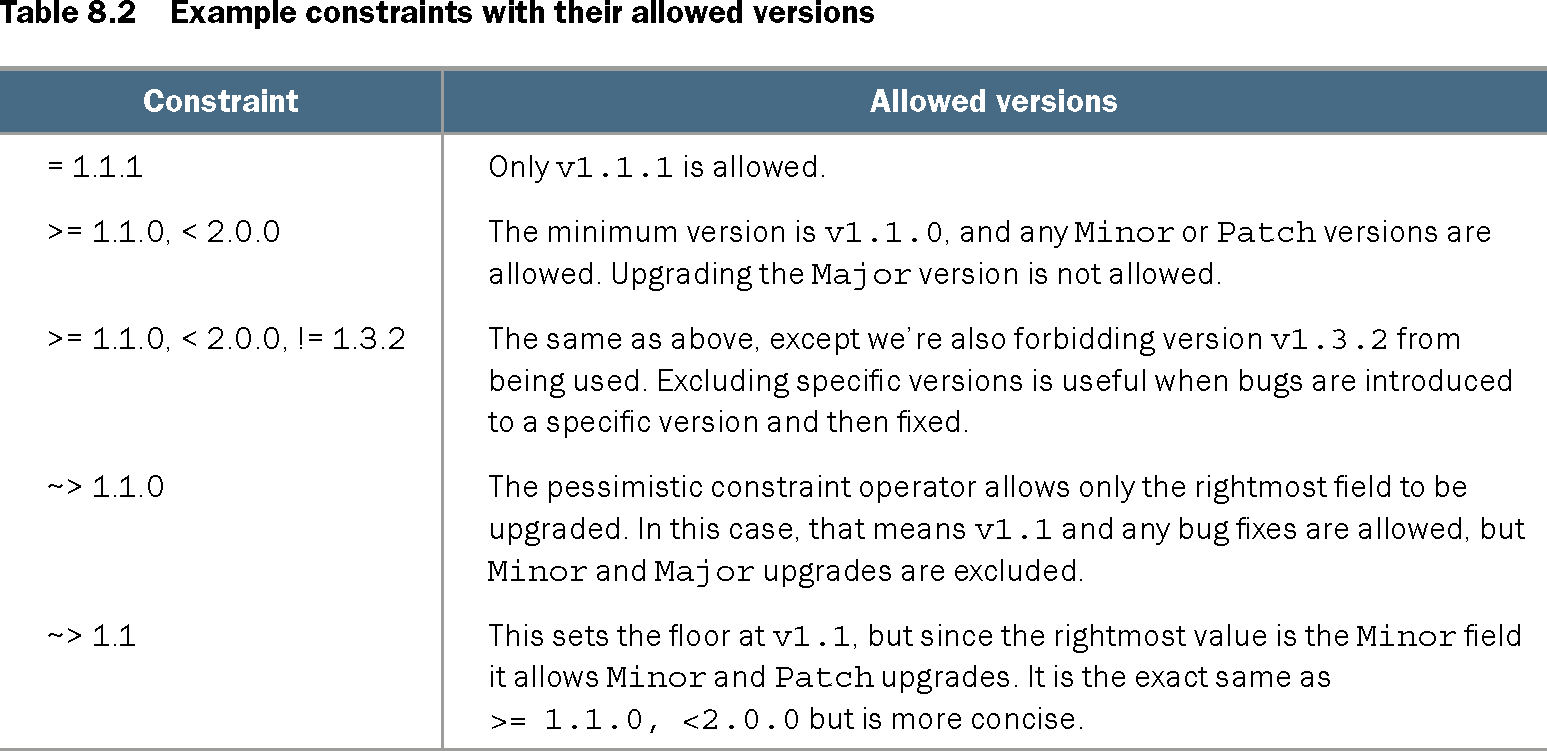
A module can pin one exact release with version = "1.1.1", allow minor and patch updates below 2.0.0 with version = ">= 1.1.0, < 2.0.0", or exclude a known-bad release with version = ">= 1.1.0, < 2.0.0, != 1.3.2". The pessimistic constraint "~> 1.1.0" permits bug fixes within the 1.1 line, while "~> 1.1" permits minor and patch updates below 2.0.0. section 8.1.1
Table 8.2 Example constraints with their allowed versions (view table figure)
| Constraint |
Allowed versions |
|---|---|
| = 1.1.1 |
Only v1.1.1 is allowed. |
| >= 1.1.0, < 2.0.0 |
The minimum version is v1.1.0, and any Minor or Patch versions are allowed. Upgrading the Major version is not allowed. |
| >= 1.1.0, < 2.0.0, != 1.3.2 |
The same as above, except we’re also forbidding version v1.3.2 from being used. Excluding specific versions is useful when bugs are introduced to a specific version and then fixed. |
| ~> 1.1.0 |
The pessimistic constraint operator allows only the rightmost field to be upgraded. In this case, that means v1.1 and any bug fixes are allowed, but Minor and Major upgrades are excluded. |
| ~> 1.1 |
This sets the floor at v1.1, but since the rightmost value is the Minor field it allows Minor and Patch upgrades. It is the exact same as >= 1.1.0, <2.0.0 but is more concise. |
Compare exact, bounded, exclusion, and pessimistic constraints with their allowed versions. section 8.1.1
Table 8.1 Example changelog and semantic versions (view table figure)
| Change |
Field to increment |
Version |
|---|---|---|
| First stable release |
v1.0.0 |
|
| Fix error in variable validation |
Patch |
v1.0.1 |
| Improve documentation |
Patch |
v1.0.2 |
| Expose additional resource parameters as variables |
Minor |
v1.1.0 |
| Fix TFLint rule violation |
Patch |
v1.1.1 |
| Refactor input variable names |
Major |
v2.0.0 |
Map representative module changes to the version field they increment. section 8.1.1