Semantics makes data meaning explicit by modeling typed entities, attributes, and meaningful named relationships within a domain knowledge graph. This structure supports contextual knowledge, explainability, and reasoning. section 1.4.1
Semantic modeling typically combines:
- Taxonomies organize categories hierarchically through broader–narrower relationships, such as Vehicle, Car, and Sedan. section 1.6.1
- Ontologies define identity, difference, disjointness, unions, complements, and cardinality restrictions among concepts. section 1.6.1
- Modern knowledge graphs often apply just enough semantics: partial, extensible models that address current domain needs without rigid completeness. section 1.6.1
Healthcare domain
A healthcare knowledge graph may begin with an oncology or cardiology ontology, then expand into additional specialties as requirements evolve. section 1.6.1
Figure 1.6 The four pillars of KGs: evolution, semantics, integration, and learning
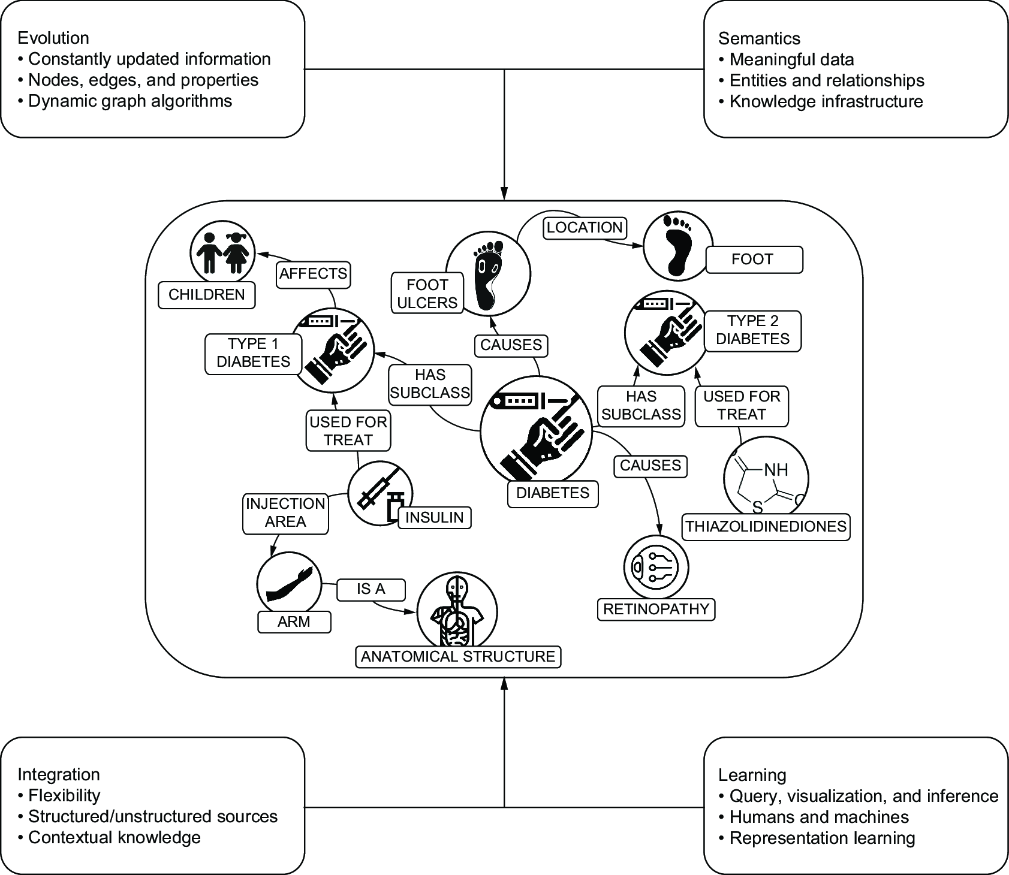
Use the four-pillar view to relate semantics to evolution, integration, and learning in knowledge graphs. section 1.4.1

