Semantics concerns meaning: what expressions signify and how concepts relate. It differs from syntax, the formal arrangement and manipulation of symbols. A sentence can be grammatically well formed yet fail to describe a coherent situation; “Colorless green ideas sleep furiously” illustrates the contrast. section 1.5.4 section 2.6.1
Meaning is not always carried by words in isolation. Context, intent, and the surrounding conversation help determine how an expression is interpreted. For language models, the challenge is to generalize across different expressions without losing meaningful distinctions. section 2.0 section 2.6.1
The Chinese Room thought experiment asks whether following rules to produce fluent Chinese replies amounts to understanding Chinese. John Searle argued that manipulating symbols according to their syntax is insufficient for semantics. Critics respond that understanding might belong to the whole system, rather than to the person following the rules alone. section 1.5.4
Large language models complicate this distinction. Patterns of word use can organize representations so that words appearing in similar contexts lie near one another. This provides a relational form of semantics: it captures relationships within language, but does not by itself establish a direct connection to the world described. section 1.5.6 section 1.5.7
Figure 2.9 A simplified two-dimensional illustration of an embedding space. Words that appear in similar contexts cluster together, with more similar words positioned closer to each other, such as “dog” and “wolf” or “fork” and “knife.” Arrows indicate consistent directional relationships, such as the shift between masculine and feminine forms shown in the “Royalty” group. The axes have no inherent linguistic meaning; they are learned dimensions that reflect statistical patterns in language use.
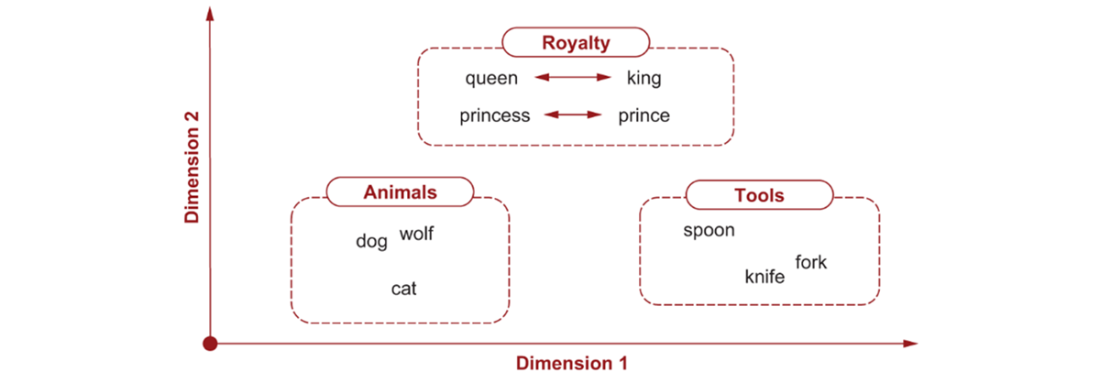
The embedding-space illustration shows word clusters and recurring directions of change. Its two-dimensional layout is a simplification of higher-dimensional learned representations. section 2.5.4
Whether learned relationships count as meaning depends on the criteria used. If semantics requires grounding in perception and experience, statistical relationships alone fall short. If it can consist in structured relations between concepts, they may constitute a limited form of semantics. Fluent output does not settle the question: behavior is observable, while the presence of understanding is harder to establish. section 1.5.7 section 1.5.5
This distinction matters in professional use. Convincing answers are not, by themselves, evidence that a system can assess their meaning or consequences; decisions about trust, verification, and oversight require evaluation in context. section 1.1.4



