Semi-structured data combines organized metadata with unstructured content rather than fitting entirely into a rigid table. In fraud detection, an email can pair sender IP address, timestamp, and domain with message text and headers. section 1.5
Its modality guides fraud-detection design:
- Use rules-based systems when structured data is limited or only a few exceptional scenarios must be covered. section 1.5 section 1.7
- Combine rules, machine learning, and deep learning when structured metadata appears alongside text, speech, images, or other raw content. section 1.5 section 1.7
- For phishing, inspect sender metadata and communication content together, then deploy detection on relevant email, mobile, or network infrastructure. section 1.5.1
Identity verification
A banking account-opening flow may combine IP address, mouse-click frequency, and typing speed with textual form responses and submitted images. This semi-structured setup can support detection of stolen identities alongside structured metadata and image-based checks. section 1.5.2
Figure 1.14 Three ways of categorizing online fraud: the industry or sector in which fraud is perpetrated, the nature of the fraudulent attack, and the modalities of data involved.
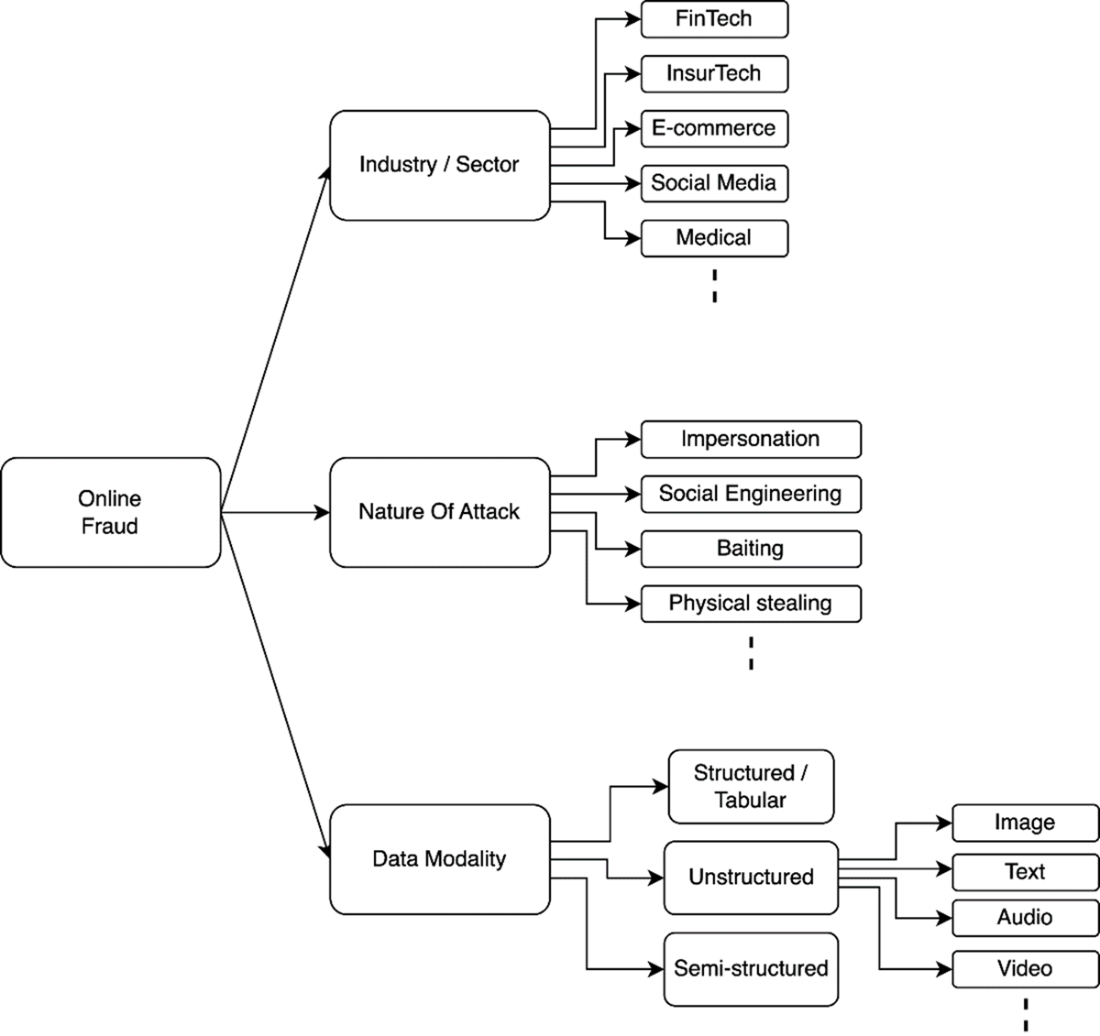
Use the figure to frame semi-structured data alongside the industry and attack-nature lenses when specifying fraud-detection requirements. section 1.5